

Close
Most organisations track numbers very well. Dashboards are reviewed regularly. Reports are shared. Leaders know what is up and what is down. On paper, performance appears under control.
Yet many leaders quietly sense something is off.
Teams are busy, but priorities feel scattered. Targets are met, but momentum is missing. Strategy exists, but execution does not seem to shift in any meaningful way.
This is often where the question of KPI vs OKR enters the conversation.
Not as a framework debate, but as a deeper leadership discomfort. Something is being measured correctly, yet something important is not moving.
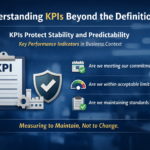 KPI Full Form and Meaning in Business Context
KPI stands for Key Performance Indicator.
In its simplest form, KPI is a measurable indicator that shows whether a critical part of the organisation is performing as expected.
KPIs are designed to protect stability. They help leaders ensure that operations remain healthy and predictable.
They answer questions such as:
KPIs do not exist to provoke change. They exist to prevent breakdown.
Not all metrics qualify as KPIs. This distinction between metrics vs KPI is important.
Metrics are measurements. KPIs are choices.
A KPI is selected because leadership agrees that this measure reflects something vital to the organisation’s health.
Examples of key performance indicators include:
These KPI examples help leaders monitor performance. They do not automatically create progress. That is not their role.
Another word for KPI may be performance indicator, but its purpose remains the same; to signal whether the system is functioning within defined boundaries.
OKR stands for Objectives and Key Results.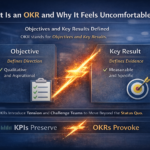
While KPIs are about maintaining performance, OKRs are about changing it.
This difference explains why OKRs often feel unsettling. They introduce tension into the system. They challenge teams to move beyond what is currently working.
Understanding what is an OKR vs KPI begins with understanding intent.
KPIs preserve OKRs provoke.
The structure of OKRs is deceptively simple, yet frequently misunderstood.
An Objective defines direction It is qualitative and aspirational.
A Key Result defines evidence It is measurable and specific.
For example:
Objective: Improve customer trust
Key Results:
This distinction between objective and key result matters because objectives without key results become slogans and key results without objectives become tasks.
This is the core of Objective Key Results vs KPI thinking.
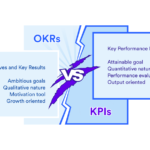
The most meaningful difference between KPI and OKR is not structure. It is purpose.
KPIs answer the question – Are we performing acceptably
OKRs answer the question – What must change for us to move forward
KPIs are inherently conservative. They reward consistency and predictability.
OKRs are deliberately ambitious. They reward learning and stretch.
This is why treating OKRs like KPIs usually leads to disappointment. The system resists risk and OKRs lose their power.
Consider a customer support function.
KPIs in this context typically include:
These KPIs exist to ensure reliability, consistency and operational discipline. They help leaders answer a basic but essential question: Is the support function delivering service at an acceptable standard, day after day?
Over time, the numbers began to improve. Response times reduced quarter after quarter. Tickets were closed faster. On the surface, service levels looked strong.
Yet the experience beneath the metrics told a different story. Agents focused narrowly on closing cases rather than understanding underlying issues. Repeat complaints increased quietly, even as efficiency metrics continued to improve.
The KPIs were doing their job. They were optimising speed, not ownership.
For the same team, an OKR serves a different purpose.
Once the OKR was introduced, conversations within the team began to shift.
Instead of asking how quickly tickets could be closed, agents started discussing why certain issues were recurring. Patterns were identified. Preventive fixes were proposed. Teams collaborated across functions to address root causes rather than symptoms.
Decisions slowed slightly at first, but ownership increased. Over time, repeat complaints reduced, customer conversations became more meaningful, and learning started feeding back into system improvements.
Objective: Create a customer support experience that builds long-term loyalty
Key Results:
While KPIs protected the current level of service, the OKR reshaped how the team thought about impact. It redirected attention from transactional efficiency to long-term value creation.
Both matter, but they do not compete.
KPIs keep the system steady, while OKRs push the system forward.
One of the simplest ways to understand the difference between KPIs and OKRs is to observe what happens when a KPI is reframed as an OKR.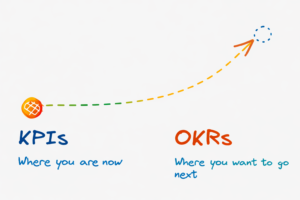
Consider a commonly used KPI:
Employee attrition below twelve percent.
As a KPI, it serves a monitoring function. It tells leaders whether people are leaving at an acceptable rate. It signals risk, but it does not explain intent.
Now consider the same issue reframed as an OKR.
Objective: Create a workplace where employees choose to stay and grow
Key Results:
The metric remains present, but the purpose changes. The OKR invites leaders to explore why people stay, what growth looks like and how leadership behaviour influences retention.
This is where the real difference between KPI and OKR becomes visible. KPIs observe outcomes. OKRs demand ownership of causes.
KPIs are not inferior to OKRs. They are simply designed for a different job.
KPIs work best when:
Areas such as payroll accuracy, safety compliance, manufacturing quality and service-level adherence depend heavily on KPIs. In these contexts, KPIs do not limit performance. They protect it.
Attempting to introduce OKRs into such systems without need often creates noise rather than value.
OKRs become relevant when performance plateaus or direction feels unclear.
They are particularly useful when:
In these moments, the difference between OKR and KPI is not theoretical. It is felt in everyday decisions.
KPIs keep teams efficient while OKRs force teams to make choices.
Organisations that mature in their approach do not replace KPIs with OKRs. They use KPIs to protect the base and OKRs to stretch the future.
Most challenges with KPIs and OKRs do not stem from poor design but from poor intent.
Common patterns include:
These issues are cultural rather than technical. They reflect how safe people feel taking risks and how clearly leaders communicate priorities.
Without trust and clarity, even the best-designed OKR framework becomes performative.
When used well, KPIs and OKRs reinforce each other.
Effective practice includes:
Most importantly, leaders must recognise that OKRs require maturity.
If failure is punished, ambition will shrink. If learning is valued, progress accelerates.
Understanding the difference between KPIs and OKRs is only the first step. The real value comes from how leaders act on this understanding.
Step 1: Clarify What Needs Stability and What Needs Change
Begin by identifying which parts of the business need consistency and control, and which parts need movement and reinvention. Use KPIs where reliability matters. Use OKRs where direction and momentum are required. Mixing the two without clarity creates confusion.
Step 2: Design OKRs Around Strategic Tension, Not Comfort
Ensure OKRs are anchored in real business challenges, not incremental improvements. If an objective feels safe or easily achievable, it is likely functioning as a KPI. Effective OKRs create productive discomfort and force meaningful choices.
Step 3: Build Review Rhythms That Encourage Learning, Not Just Reporting
Review KPIs to ensure discipline. Review OKRs to surface insights, course corrections and learning. When reviews focus only on numbers and not on behaviour, OKRs lose their intent and become another reporting exercise.
What is the difference between OKR and KPI in simple terms
KPIs track whether performance is acceptable.
OKRs define what needs to change to improve performance.
Are OKRs and KPIs the same as metrics
No. Metrics are measurements.
KPIs and OKRs are leadership decisions about which measurements matter and why.
Can the same metric be both a KPI and a key result
Yes, depending on context, but not at the same time. Its role depends on intent.
Do OKRs replace KPIs
No. OKRs do not replace KPIs. They sit above them and give direction to improvement.
The conversation around KPI vs OKR is rarely about frameworks. It is about leadership intent.
KPIs keep the organisation functioning.
OKRs challenge the organisation to evolve.
When leaders understand this distinction, performance stops being the final goal and becomes the foundation for progress.
That is when movement begins.
Are your performance measures helping your organisation move, or only helping it report?
At The Yellow Spot, we work with leaders and teams to move beyond measurement and build clarity, ownership and strategic alignment. If you are revisiting how KPIs and OKRs are shaping behaviour in your organisation, this is a conversation worth having.
Visit:
🌐 www.theyellowspot.com
📧 info@theyellowspot.com
📞 India: +91 99677 14310 / +91 87792 84314