Organisations rarely collapse overnight. They slowly weaken through disengaged employees, confused priorities, siloed teams, and leaders who are busy but not effective. What looks like a performance issue on the surface is often a systemic issue underneath.
This is precisely why organizational development matters more today than ever before.
In a world shaped by constant disruption, digital transformation, hybrid work, generational shifts, and rising expectations; organisations can no longer rely on ad-hoc training or policy changes. They need a deliberate, structured, and human-centred approach to change. That approach is organisational development.
This blog explores what is organisational development, its objectives, features, interventions, importance, and the role of HR—going beyond definitions to practical, workplace-relevant examples.
Let’s first address the fundamental question: what is organisational development?
Organisational Development (OD) is a planned and systematic process aimed at improving organisational effectiveness by aligning people, processes, structures, and culture with strategic goals. It focuses on long-term capability building rather than short-term fixes.
Unlike isolated training programs, organizational development examines the organisation as a living system. It asks questions such as:
From an HR lens, what is organizational development in HR becomes clearer, it is HR’s strategic responsibility to enable change, improve organisational health, and strengthen leadership and behavioural capability across the enterprise.
In simple terms, organizational development ensures that how people work supports what the organisation is trying to achieve.
The objectives of organizational development go well beyond productivity metrics. They focus on strengthening the organisation’s ability to perform consistently over time.
Key objectives include:
For example, when a fast-growing organisation promotes technical experts into managerial roles without building leadership capability, OD interventions help bridge the gap preventing burnout, attrition, and role confusion.
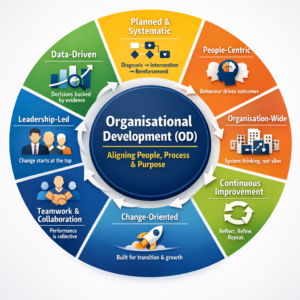
Let’s now dive deeper into the features of organizational development, with practical examples that reflect real workplace challenges.
Organizational development is not a reaction to a crisis; it is a planned and structured organisational development process.
It typically follows these stages:
For instance, instead of immediately launching a leadership program because “managers lack accountability,” an OD approach first diagnoses why accountability is missing like unclear roles, weak feedback culture, or misaligned KPIs.
This systematic nature ensures sustainable change, not temporary enthusiasm.
A defining feature of organizational development is its strong emphasis on people and behaviour.
OD is deeply rooted in the characteristics of organisational behaviour like motivation, communication patterns, leadership styles, group dynamics, and resistance to change.
A company may introduce a new performance system, but unless managers are equipped to hold honest conversations and employees feel psychologically safe, the system fails. OD addresses this behavioural layer, not just the process.
Because systems don’t resist change, people do.
Unlike training initiatives that target specific groups, organizational development adopts an organisation-wide approach.
It recognises that issues rarely exist in isolation. A breakdown in collaboration between sales and operations, for instance, is not a “sales problem” or an “operations problem”, it’s a system problem.
Understanding what organisation as an interconnected system is allows OD efforts to improve alignment across departments, levels, and functions rather than optimising one area at the cost of another.
Another critical feature of organizational development is its focus on continuous improvement.
OD is not a one-time project with a neat end date. It builds mechanisms for regular reflection, feedback, and course correction.
For instance, organisations practising continuous OD conduct periodic culture check-ins, leadership reviews, and engagement assessments using insights to refine practices rather than waiting for attrition or conflict to surface.
In short, OD replaces “fix and forget” with “learn and evolve.”
Effective organizational development relies on data rather than assumptions.
Employee surveys, focus group insights, behavioural assessments, leadership diagnostics, and performance data inform decisions. This data-driven approach adds credibility and reduces bias—especially when dealing with sensitive issues like leadership effectiveness or culture.
Rather than assuming “employees are disengaged,” OD uses data to identify what exactly is disengaging them, lack of clarity, poor manager capability, or limited growth opportunities.
No organizational development effort can succeed without strong top management support.
Leadership commitment signals seriousness. When leaders model desired behaviours such as openness to feedback, collaboration, accountability, OD efforts gain traction.
Conversely, when leadership behaviour remains unchanged, OD initiatives quietly die, no matter how well designed they are.
In OD, leadership is not a sponsor but the starting point.
Organizational development recognises that work happens through teams, not job descriptions.
By strengthening teamwork, trust, and shared accountability, OD directly improves performance outcomes. This connects closely with the scope of organisational behaviour, where team norms and interpersonal dynamics shape results.
For example, OD interventions often address unclear roles, unspoken conflicts, or silo mindsets that block collaboration. These issues cannot be solved by technical training alone.
At its core, organizational development is change-oriented.
It equips organisations to manage transitions like mergers, restructuring, digital adoption, leadership shifts without destabilising performance.
Rather than reacting to change, OD builds the capability to anticipate, absorb, and sustain it.
Organisational development interventions are the practical actions that translate diagnosis into change.
Common interventions include:
Well-designed organizational development training ensures these interventions lead to behavioural change, not just awareness.
Many organisations today also engage external partners for organizational development services to bring objectivity, expertise, and scalability to complex change initiatives.
The importance of organizational development lies in its ability to future-proof organisations, not just fix present-day problems.
In reality, most organisational challenges are not technical, they are behavioural, cultural, and systemic. Missed deadlines, poor accountability, low engagement, leadership fatigue, and resistance to change are rarely caused by lack of skill alone. They stem from unclear priorities, misaligned systems, weak decision-making norms, and cultures that unintentionally reward the wrong behaviours.
Organisations that invest in organizational development are better equipped to:
Navigate uncertainty and disruption
OD builds adaptability into the system. Instead of reacting defensively to change market shifts, restructuring, digital transformation, organisations develop the capability to anticipate, absorb, and respond with clarity.
Reduce resistance to change
Resistance often arises when change is done to people rather than with them. OD uses participation, communication, and trust-building to convert resistance into ownership.
Build strong leadership pipelines
Rather than depending on a few high performers, OD creates leadership capacity across levels ensuring continuity, better succession, and distributed decision-making.
Improve engagement and retention
People stay where they feel heard, trusted, and challenged meaningfully. OD addresses these deeper drivers of engagement instead of relying on surface-level engagement initiatives.
Align culture with strategy
Strategy fails when culture doesn’t support it. OD ensures that everyday behaviours, leadership norms, and decision-making patterns reinforce strategic intent rather than quietly undermine it.
Deliver consistent and sustainable performance
OD shifts organisations away from heroic effort and firefighting towards reliable systems, clear roles, and shared accountability.
In environments where talent mobility is high, expectations are evolving, and trust is fragile, organizational development becomes the foundation for sustainable growth; not a “nice to have,” and certainly not a one-time intervention.
HR plays a pivotal and non-negotiable role in driving organizational development.
In an OD-led organisation, HR is no longer a support function working on the sidelines, it becomes a strategic enabler of organisational effectiveness.
Key responsibilities include:
By leveraging the scope of organisational behaviour, HR ensures that people practices actively support business strategy instead of operating in silos.
When HR leads organizational development effectively, it moves beyond administration and execution—it becomes a custodian of culture, capability, and long-term organisational impact.
Organizational development is not about fixing individuals, it’s about strengthening the system in which individuals operate.
At The Yellow Spot, we view organizational development as a deep-impact journey, not a standalone initiative. Real change happens when organisations invest in diagnosis, leadership alignment, behavioural shifts, and sustained reinforcement, not just workshops or policy changes.
Our experience across industries shows one clear pattern:
Organisations that treat OD as a continuous capability outperform those that treat it as an intervention.
When the organizational development process is designed thoughtfully, supported by leadership, and grounded in behavioural insight, organisations don’t just manage change, they grow through it.
If your organisation is navigating growth, transformation, leadership transitions, or cultural challenges, it may be time to look beyond quick fixes.
Explore how organizational development training and services can help your organisation build clarity, capability, and cohesion at every level.
Connect with The Yellow Spot to design an organisational development approach that is practical, people-centred, and built for real workplace impact.
Because sustainable performance doesn’t happen by chance, it is designed.


Blue Arch CHS, Louis School Lane, Four Bungalows, Andheri West, Mumbai – 400053