

The first day at a new job is rarely about work. It’s about decoding a new world.
You walk in, trying to read the room. Who seems approachable? How formal is the environment? Is it okay to ask questions freely, or do people figure things out on their own? You’re listening carefully, not just to what’s being said—but to what’s not being said.
And somewhere between introductions, login credentials, and a welcome presentation, one quiet thought begins to form:
“Do I belong here?”
This is the moment most organisations underestimate.
Because what happens in those first few days is not just orientation—it is the beginning of performance, engagement, and retention. This is where induction training becomes far more than a process. It becomes the first step to success.
For instance, Google has built one of the most talked-about induction (onboarding) experiences, not because it is flashy, but because it is thoughtfully structured around how people actually learn and settle into a new environment.

Instead of overwhelming new hires with excessive information on Day 1, Google follows a phased approach. New employees—often called “Nooglers”—are introduced to the organisation in manageable layers. They receive clear role expectations early, along with access to resources that help them understand not just what to do, but how to do it effectively within Google’s ecosystem.
One of the most impactful elements is the use of “buddy systems,” where a peer helps the new joiner navigate informal processes, answer everyday questions, and settle in faster. Managers are also actively involved from the beginning, ensuring alignment on priorities and expectations.
What makes this approach effective is its balance—structured enough to provide clarity, but flexible enough to avoid overload. The focus is not just on information delivery, but on integration, confidence-building, and early contribution.
It’s a strong reminder that induction training works best when it is designed around the employee’s experience, not just the organisation’s agenda.
On paper, induction training is defined as the process of introducing new employees to an organisation: its culture, policies, people, and processes.
But in reality, that definition is incomplete.
Induction training is not just about giving information. It is about helping a person transition from being an outsider to becoming an insider.
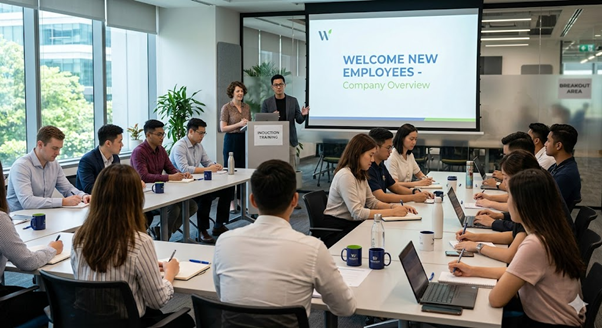
Every new employee is trying to answer three things:
Most induction programs answer the first question reasonably well. They talk about the organisation, its achievements, its structure.
But the real gap lies in the second and third.
Because knowing the company is not the same as knowing how to function within it.
There’s a belief that people “settle in” over time. That if they’re capable, they’ll figure things out.
And yes, many do. But at what cost?
Without effective induction training:
What’s worse is that these issues don’t always show up immediately. They appear gradually—in missed expectations, in confusion during decision-making, in hesitation during conversations.
A fast-growing startup hired a group of high-potential employees from top organisations. Their induction program was efficient—one day of presentations, access to documents, and introductions.
Three months later, the leadership team noticed something strange. The hires were smart, capable, and motivated, but they weren’t delivering at the expected level.
On closer observation, the issue became clear:
The problem wasn’t capability. It was lack of contextual clarity.
When the organisation redesigned its induction to include:
performance improved significantly within weeks.
The difference wasn’t more information—it was better alignment.
Induction training is often designed as a checklist. But its real purpose is far more layered.
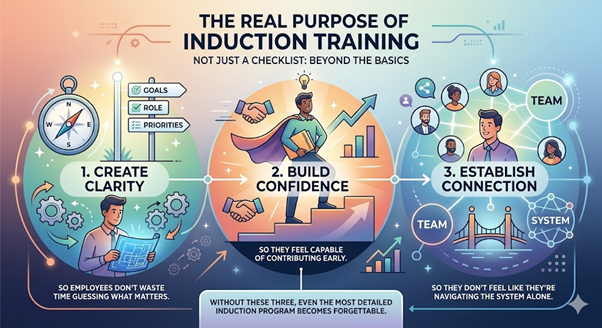
At its core, effective induction training should:
So employees don’t waste time guessing what matters.
So they feel capable of contributing early.
So they don’t feel like they’re navigating the system alone.
Without these three, even the most detailed induction program becomes forgettable.
A good induction program doesn’t overwhelm. It guides.
And it does so by building understanding step by step.
Most organisations begin induction with presentations about vision, mission, and structure.
That’s useful—but insufficient.
What employees really need is context that helps them understand:
In one organisation, employees were told “collaboration is key.” But in practice, decisions were made top-down.
New employees who took collaboration literally struggled. Those who observed behaviour adapted faster.
Induction training should bridge this gap between stated values and lived reality.
If there is one area where induction training often fails, it is here.
Employees join with a job description—but very little clarity on:
A newly promoted manager joined a large organisation. The induction covered policies, systems, and organisational structure.
But no one clearly explained:
Within two months, the manager was overwhelmed—not because of incompetence, but because of unclear expectations.
When structured role clarity sessions were introduced, performance stabilised quickly.
The lesson:
Clarity reduces anxiety. And anxiety directly affects performance.
Every organisation has an informal structure.
Who influences decisions.
Who needs to be aligned.
Who can unblock work.
New employees don’t know this.
So they either:
Induction training should actively help employees build this map early.
Most induction programs try to cover everything upfront.
The result? Employees remember very little.
A better approach is:
Learning sticks when it is relevant.
Culture is rarely what is written—it is what is practiced.
Induction should answer:
In one organisation, new hires were encouraged to “take initiative.” But when they did, they were told to “follow process.”
The confusion led to hesitation.Induction training must make behavioural expectations explicit—not assumed.
Even well-intentioned programs fall into patterns that reduce effectiveness.
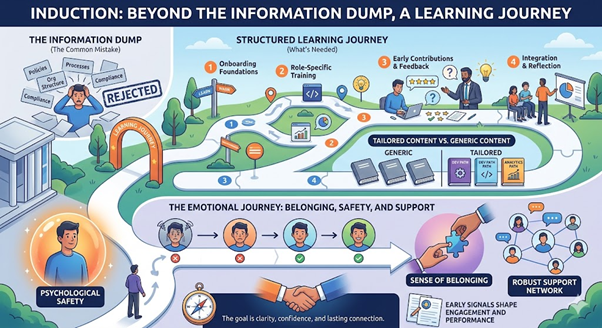
A common mistake in induction training is treating it as a one-time information dump rather than a structured learning journey. Everything gets shared at once, but very little is actually absorbed. Induction often ends too early—before employees have had the chance to apply, question, or truly understand what they’ve learned.
On top of that, many organisations rely on generic content, giving everyone the same inputs regardless of their role, level, or context, which reduces relevance and engagement. Perhaps the most overlooked aspect, however, is the emotional experience of joining. Induction is not just about understanding processes; it is about how employees feel in a new environment.
They are constantly evaluating whether they feel safe, whether they belong, and whether they have the support they need. And these early emotional signals quietly shape how they show up, engage, and perform in the organisation.
When induction training is done right, the impact is visible and measurable.
Employees begin contributing faster—not because they are pushed, but because they understand. They collaborate more effectively because they know who to engage. They stay longer because the early experience feels structured and supportive.
Over time, organisations see:
Induction doesn’t just start the journey—it shapes it.
Effective induction training requires intentional design.
Induction should extend into the first few months.
Because real questions emerge only after employees begin working.
People don’t learn by listening—they learn by engaging.
Use:
Buddy systems and mentors accelerate integration.
They give employees:
Ask regularly:
Induction improves when feedback is continuous.
Induction training is where culture becomes visible.
What you emphasise early becomes what employees prioritise later.
If induction focuses only on compliance, employees become compliance-driven.
If it focuses on ownership and accountability, those behaviours emerge naturally.
Induction is not just onboarding. It is culture in action.
Induction training is often treated as a starting formality.
In reality, it is a strategic advantage.
It shapes how employees think, act, and perform from the very beginning. It reduces uncertainty, builds confidence, and creates alignment.
Because most performance issues don’t come from lack of capability.
They come from unclear beginnings.
And when the beginning is right, everything that follows becomes easier.
At The Yellow Spot, we design induction training experiences that go beyond orientation—focusing on clarity, capability, and real workplace application. Whether you’re onboarding fresh talent or experienced managers, we help ensure your people don’t just join—they integrate, contribute, and succeed.
If you’re looking to transform your induction training into a true first step to success, let’s start that conversation.