In today’s fast-moving work environment, technical expertise alone no longer guarantees effectiveness. What truly differentiates high performers from overwhelmed professionals is their ability to manage themselves. Self management skills sit quietly behind consistent results, emotional balance and leadership credibility. They influence how individuals plan their work, regulate emotions, respond to pressure and stay aligned with their goals even when circumstances change.
Simply put, self management is the foundation on which all other management skills are built. Without it, even the most talented professionals struggle to sustain performance. With it, individuals become reliable, focused and resilient contributors at every level of an organisation.
This article explores what self management skills really mean, why they matter more than ever and how individuals and organisations can build them intentionally.
The answer is in the question itself. Self management the phrase says it all. It is the ability to regulate one’s thoughts, emotions, time and behaviour in a way that supports personal and professional goals. At its core, it quietly asks a powerful question: how effectively do I manage myself when no one is watching?
When people ask what is self management skills or request to explain self management skills, the answer goes beyond productivity hacks or discipline. Self management is about conscious choice. It is the ability to pause, prioritise and respond rather than react.
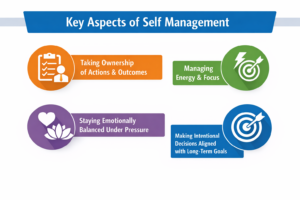
In essence, self management is self leadership in action. It is how individuals lead themselves before they are expected to lead others.
Why is self management important in today’s workplace? Because the workplace itself is changing at a rapid pace. Ambiguity, speed and constant change are no longer exceptions. They are the norm. External control has reduced significantly, while internal clarity has become essential.
Consider a manager working in a hybrid setup. There is no constant supervision, priorities shift daily and teams are distributed. In such an environment, performance is no longer driven by instructions. It is driven by how well the individual manages focus, emotions and decision-making in moments of uncertainty.
Our success in both professional and personal contexts is directly linked to how well we take charge of our own emotions, behaviours and responses.
For example, when deadlines tighten, a professional with strong self management skills resists panic and prioritises effectively. When feedback feels uncomfortable, they respond with reflection rather than defensiveness. When plans change, they adapt without disengaging.
When individuals develop strong self management skills, they are better equipped to:
Over time, these everyday choices compound. Individuals become more dependable, leaders become more credible and teams operate with greater stability and trust. Self management is no longer a personal efficiency skill. It has become a core capability that directly influences performance, relationships and long-term success in the workplace.
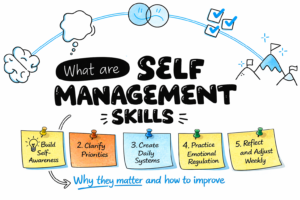 Self management is not a single ability. It is a set of skills that show up in everyday workplace behaviour. These skills influence how individuals plan their work, respond to pressure and take responsibility for outcomes. When developed intentionally, they create visible shifts in performance and credibility.
Time management becomes visible in small, everyday choices. It is the employee who starts the day by deciding what truly needs attention instead of immediately diving into emails. It is the manager who protects thinking time and preparation time rather than allowing the calendar to run the day. Over time, this ability to prioritise reduces last-minute pressure and replaces constant urgency with steady progress.
Goal setting provides direction to effort. Without clarity, even hard work becomes scattered.
A professional with strong self management skills sets clear short-term and long-term goals. They break large objectives into achievable steps and review progress regularly. For example, instead of vaguely aiming to “perform better,” they define what success looks like, track outcomes and course-correct when required. Goal setting turns intention into action.
Effective self managers:
Self motivation is the ability to stay engaged even when external supervision is minimal.
In today’s workplace, this is seen when individuals take initiative without being reminded, follow through on commitments and remain consistent during slow or challenging phases.
A self-motivated employee does not wait for pressure to perform. They connect their work to a larger purpose and sustain momentum even when recognition is delayed.
Pressure is inevitable. How individuals respond to it defines their effectiveness.
Stress management is visible when a professional remains composed during tight deadlines or difficult conversations. Instead of reacting emotionally, they pause, organise their thoughts and respond thoughtfully. Over time, this emotional regulation builds trust, especially in leadership roles where teams look for stability during uncertainty.
Decision making is a daily expression of self management.
In the workplace, strong decision-making skills are seen when individuals gather relevant information, consider consequences and take ownership of their choices. Rather than delaying decisions out of fear or making impulsive calls under pressure, they balance speed with judgement. Even when outcomes are not perfect, they reflect and learn rather than deflect responsibility.
Adaptability reflects the ability to adjust without losing direction.
A professional with strong adaptability does not resist change instinctively. When priorities shift or processes evolve, they reassess, learn and realign their approach. For example, when a project changes midway, they focus on what can be influenced rather than what was lost. This flexibility keeps performance steady in dynamic environments.
Accountability is the backbone of self management.
It shows up when individuals own both success and failure.
In the workplace, this means acknowledging mistakes early, communicating transparently and focusing on solutions. Accountable professionals do not rely on excuses. They take responsibility for outcomes and follow through on corrective actions, strengthening trust and credibility over time.
Self management often reveals itself in ordinary moments.
 A team member receives a last-minute request late in the day. Instead of reacting with frustration or immediately saying yes, they assess priorities, communicate clearly and negotiate timelines realistically. The work gets done without resentment or burnout.
Or take a leader handling a tense team discussion. Emotions are running high and opinions differ. Instead of asserting authority or shutting the conversation down, the leader listens, regulates their response and guides the discussion toward solutions. The meeting ends with clarity rather than conflict.
In both cases, outcomes are shaped not by external control but by internal regulation. The ability to pause, choose and act intentionally makes all the difference.
The benefits of self management extend far beyond personal productivity. When individuals manage their thoughts, emotions and actions effectively, performance improves, relationships strengthen and work becomes more sustainable.
People with strong self management experience greater focus, reduced emotional fatigue and stronger professional credibility. Decision making improves because responses are intentional rather than reactive. Workplace relationships become healthier as conversations remain constructive even during disagreement.
Over time, self management supports resilience. Careers are built steadily, not through constant urgency but through consistent, grounded effort.
Self management is not a personality trait. It is a skill that can be strengthened through practice.
Start with awareness. Notice patterns in focus, stress and behaviour. Clarity creates choice.
Prioritise intentionally. Not everything deserves equal energy.
Create simple systems such as daily planning routines or weekly reviews to reduce mental overload.
Practise emotional regulation in real time by pausing before responding and choosing thoughtful action.
Finally, review and reflect regularly. Improvement comes from adjustment, not perfection.
 Teaching self management requires more than instruction. It requires modelling, reflection and real-world application.
Effective approaches include:
When organisations integrate self management training into leadership development programs, the impact becomes visible not just in individual behaviour but in overall culture.
Practical self management techniques that work well in professional settings include:
These techniques support consistency without rigidity. They help individuals stay aligned even during high-pressure periods.
Despite good intentions, self management can feel difficult.
Common challenges include:
These challenges can be overcome by simplifying commitments, reducing noise and building reflective habits. Self management improves when individuals slow down enough to choose intentionally.
While tools alone do not create self management, the right resources can support consistency.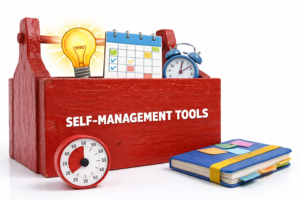
Helpful tools include:
Used wisely, these tools reinforce habits rather than replace self responsibility.
Self management skills are not soft skills. They are core management skills that influence performance, leadership effectiveness and long-term success. In a world where external control is limited, the ability to manage oneself has become a defining capability.
The true importance of self management lies in this simple truth: when individuals lead themselves well, everything else works better.
Self management shows up in behaviour, not intention.
If you want your people to think clearly under pressure, take ownership and lead themselves more effectively, that shift needs to be built deliberately.
At The Yellow Spot, we design practical interventions that create visible changes in how people show up at work.
If this feels relevant, let us connect.
Visit:
🌐 www.theyellowspot.com
📧 info@theyellowspot.com
📞 India: +91 99677 14310 / +91 87792 84314


Blue Arch CHS, Louis School Lane, Four Bungalows, Andheri West, Mumbai – 400053