

Close
Being a leader is something every employee in an organization aspires to. They want their work recognized and their commitment seen. This natural phenomenon not only transforms an employee, but changes their very style of working and shapes their outlook. In essence, leading is about progressing in the hierarchy of corporate ranks and assuming a decision-making role.
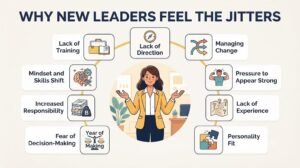
But to be a leader can also be something of a challenge. When an employee rises in the ranks and is put in a leadership role, they step into unfamiliar territory that has its own set of problems. They face situations that are new to them and do not know their practicalities or implications. This is when a leadership role looks like a burden that they themselves chose to carry.
Take the case of Rahul. His successful work profile made the manager notice him and give him a raise in salary and a higher role where he was supposed to lead a small team of employees. In this new role, Rahul was expected to oversee the employees under him and complete the projects at hand by managing to extract the best work out of his team.
Rahul soon started to worry about his new role and expectations. He was no longer executing the tasks.
He felt as if the management had snatched his role and his execution abilities. And what was worse? He had agreed to do this and cursed himself for his tomfoolery.
But what were the worries that troubled Rahul so much? Let us put on a magnifying glass and have a closer look at them. These problems are the key to understanding the challenges that a leadership role brings in its wake. But the comforting thing about these problems is that they are universal and not a rare thing. Every employee who has assumed a leadership role faces them, no matter where or when. Some of these worries are given below.
What are the factors that are worrying you about leading – fear of conflict, lack of knowledge, or facing criticism? You can work on a specific problem and find it easy to solve it rather than attempt to solve many problems at the same time.
Leaders do not necessarily have to know everything and have all the information. But they should have the skills to help others find the answer and not pretend to have all the knowledge.
Train yourself to make decisions with whatever information you have. Weigh new options before making decisions. For this to happen, they should alter their mental thinking patterns and develop the ability to foresee the consequences.
Learn to be clear in your communications. They should address the problems and look at them with an alternative perspective. This opens new choices and a fresh outlook on seeing the problem, rather than the old traditional way of looking at it. They should make a habit of asking for feedback and not blame others for the outcome.
Leaders have to trust their team and every team member’s skills. Based on those skills, they have to delegate the responsibilities and set deadlines.
It is always a good idea to discuss the problem with the mentor and get a fresh opinion about the problem. This also helps to identify other problems and solutions that they may have overlooked at first.
Even if the decision-making was successful, they should review it and learn from it. They should learn what mistakes they made and what solution they offered to solve it. This ends self-doubt and helps them identify the things that they did differently.
Leaders are not born, but honed through the correct training and coaching, and with constant practice and taking actionable steps. Taking feedback and practical application of decision-making to real-life problems of the corporate world helps more effectively. Remember that the following points are always beneficial in this regard:
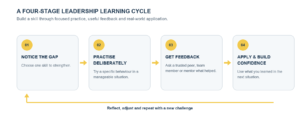
You can think of leadership as a skill that can be learned and developed. Broadly speaking, there are stages of learning leadership. You should notice a particular aspect of leadership that you need to develop. Once you have identified this, practice it and ask for feedback. Then apply this newly learned skill in your practical life and situations where you can exercise what you have learned. This is a cycle, a broader way to express yourself as a leader and take proactive action. You can understand this better from the following steps.
A newly appointed manager realizes that they are stepping in themselves to solve a particular problem instead of helping others find the solutions. They can change their behaviour and instead ask the team members to identify the problem and all the possible solutions that they can think of. Ask them to try and solve the problem and make a note of what they tried. In this way they will practice in resisting themselves taking action and allow others to initiate action and solve it.
Seek feedback from someone who is seeing your work. It could either be your team member, mentor, or peer. Ask them about your chosen way of solving problems. Also ask if they could have offered a more direct way of addressing the problem. Or what was their perception of the problem. Take this feedback and apply it the next time a similar problem arises. With each application, you will be able to identify the solution that was most effective and had the maximum impact.
You can hardly expect the learning curve to be straight. At each level you might face its own challenges. Perhaps a colleague thinks differently than you. Or, conversations that do not veer the same way as you thought they should go. There could be results that you had not anticipated, or some details that you overlooked and that had an impact on the final result. At such times, reflection is the best way to deal with the uncertainties. Guidance from experienced peers or a mentor can help you to become a wiser leader. They can guide you in the correct ways and show you how to identify opportunities and take advantage of them. Ask yourself the following questions:
Being aware of your leadership skills is the first step in developing them. But awareness is just a realization, and what you actually need is leadership training. The training that The Yellow Spot provides goes further than just training sessions and leadership programs. We focus not only on developing managerial skills, but on a personal level as well.
And this is where we work on thinking strategically, which also results in changes in behavior and outcomes. Our greatest challenge is to tailor our leadership programs to the specific role, management level, and workplace needs. Therefore, a senior-level manager may need different leadership training than a first-time manager.
You have to practice leadership yourself first and then identify the areas where you need training. This is the beauty of leadership and being a leader. Leadership is a skill, just like any other skill, and it needs to be learnt just like you learn any skill. Practice certain areas of leadership by yourself, identify solutions, and practice by implementing your ideas in real-world scenarios.
Try implementing your ideas and find out what works and what doesn’t. What feedback do your mentors or peers give you? Are your team members able to solve the problems themselves? Have you achieved the result that you expected from them? All these questions have to be answered first, and then you will decide whether you are on the road to becoming a successful leader.
