Here’s an uncomfortable truth most sales leaders would have said out loud in their planning meeting:
The skill set that made you a top performer in previous years is now a liability.
Not just obsolete but a liability. Because the reps and leaders who cling to what “worked” — the volume-based cold calling, the generic pitch decks, the gut-feel forecasting are just going to fall behind miserably. They’re actively teaching their buyers to trust them less, in a year when buyers have more ways than ever to route around a salesperson who isn’t adding value.
Buyers walking into have already done the research.They’ve used AI tools to compare vendors, summarize reviews, and shortlist options before a single human conversation happens. Multiple industry reports now confirm that a majority of B2B buyers arrive at first contact with a sales rep are already educated, sometimes more educated on the surface-level facts than the rep sitting across from them. Sales leaders surveyed for HubSpot’s 2025 sales trends work reported that a large share of sellers are already seeing this shift in how prospects gather information before they ever pick up a call.
That changes the job of a sales professional. If the buyer already has the facts, the rep’s value can no longer be “informing.” It has to be “interpreting.” Judgment, context, and trust are now the product not the information.
This is the year that gap becomes visible in the numbers. Let’s talk about what’s actually driving sales in, how ready you are for it, and more importantly what you can do about it.
Start Here: A Sales Readiness Self-Assessment
Before any strategy conversation, be honest with yourself.
Rate yourself 1 (not at all) to 5 (completely true) on each of these. Don’t optimize your answers this exercise is only useful if it may sting a little.
- I know, without checking a CRM, why my last three lost deals were lost— not the stated reason, the real one.
- I can explain what a prospect’s AI research tools have already told thembefore I walk into the conversation, rather than repeating it back to them.
- My forecast for this quarter is built on buying signals and behaviour data, not on how confident I “feel” about a deal.
- I have automated or eliminated every task in my week that doesn’t require human judgmentdata entry, scheduling, first-draft research, routine follow-ups.
- I could describe my top three customers’ business priorities for the next 12 monthswithout opening a single document.
- When I lose to a competitor, I know within 24 hoursnot at the next pipeline review.
- I treat every AI tool in my stack as a co-pilot I direct, not an autopilot I outsource to.
- My personal brand or presence would let a prospect find and vet me before I ever reach out to them
- I ask harder questions in discovery than my prospects are used to being asked.
- I could walk into a room tomorrow with zero notes and still run a credible, insight-led conversation, because the insight lives in me, not my slide deck.
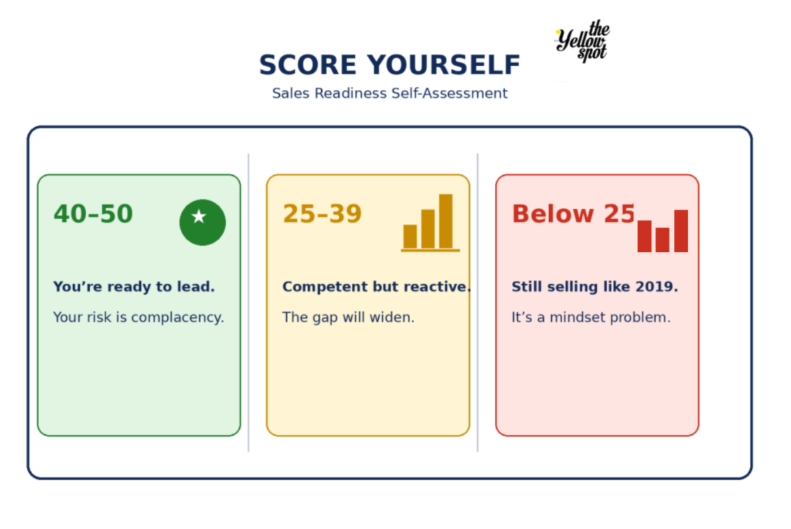
Score yourself:
- 40–50:You’re not just ready, you’re the person others will be trying to learn from. Your risk now is complacency.
- 25–39:You’re competent but reactive. you won’t compound. The gap between you and the top decile will widen.
- Below 25:You are functionally, still selling like it’s 2019 with better software. That’s not a technology problem. That’s a mindset problem, and no tool fixes it.
Most people score themselves generously the first time. Ask a manager, a peer, or better yet, a customer who didn’t buy from you, to score you honestly. The distance between those two scores is the real gap.
The Insight: What Will Actually Drive Sales
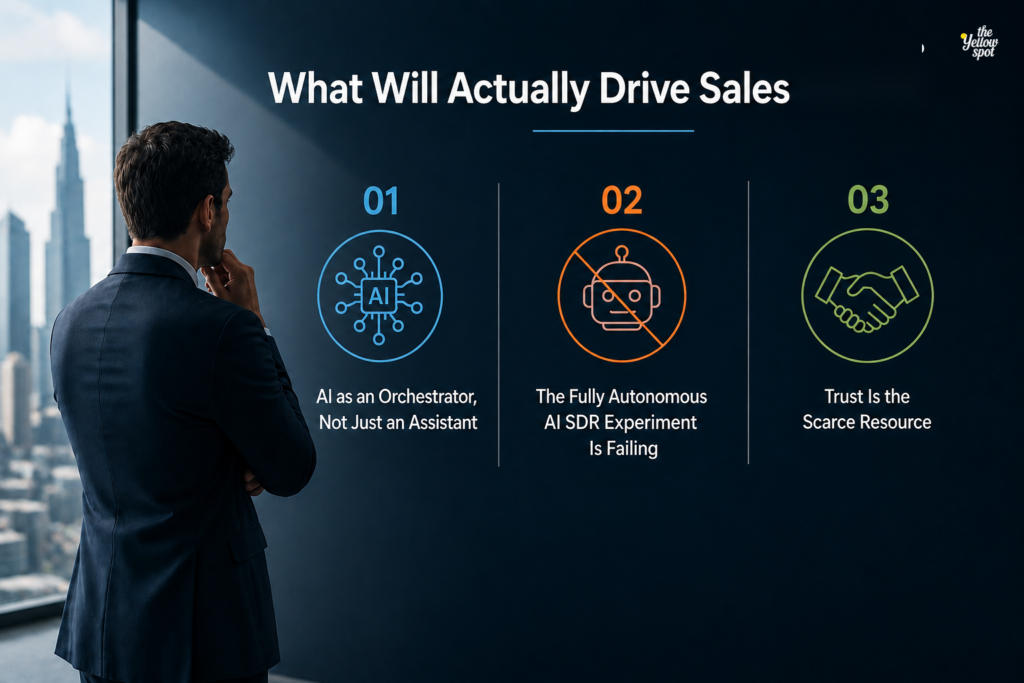
Strip away the vendor hype, and three forces are doing the real work of reshaping how deals get won this year.
- Shift of AI
AI has moved from an “assistant” to a “orchestrator” but only in the hands of teams that redesigned the workflow around it.
The organizations winning aren’t the ones with the most AI tools bolted onto an old process. They’re the ones that tore the old process apart first. Research from Gartner’s CSCO surveys shows sales organizations giving sellers AI-enabled next-best-actions are roughly 2.6 times more likely to achieve commercial growth than those that don’t. The correlation between AI upskilling and revenue growth is similarly stark. The tool isn’t the differentiator. The redesign is the one.
-
Quite Failure
The “fully autonomous AI SDR” experiment is quietly failing, and that failure is teaching the market something important.Several heavily funded startups bet on AI agents that could run an outreach from end-to-end with no human interface in the loop.The results have been underwhelming. AI-written outreach is often generic enough that sophisticated buyers spot it instantly and ignore it. Apart from this at least one high-profile platform had a serious security flaw exposed. The lesson isn’t “don’t use AI.” It’s that full autonomy without human judgment introduces exactly the kind of risk buyers are waiting to punish. The winning model is AI that makes one skilled rep operate like six, not AI that replaces the rep.
-
Scarced Resource.
Trust has become the scarce resource, and it’s being rationed by relevance.When AI has commoditized information, the rep’s only remaining edge is showing up with something the AI couldn’t have told the buyer, a pattern from a comparable deal, a challenge to an assumption, an uncomfortable question the buyer hadn’t considered. Analysts increasingly describe this as sales moving from a “reactive” (respond to inbound, work the pipeline you’re given) to “predictive” (know a deal is stalling before the buyer says a word, know who’s ready before they raise a hand).
Put together, the bottom-line is this: AI is raising the floor for everyone. It is not raising the ceiling for anyone who isn’t also raising their own judgment. The floor is now table stakes. The ceiling is still earned the old way through preparation, pattern recognition, and the willingness to say the thing your competitor’s rep won’t.
How to Make Yourself Ready
Readiness isn’t a course you complete. It’s a set of habits you install. Here’s where to start.
- Audit your calendar, not your CRM, first.
Look at last week. What percentage of your hours went to tasks a well-configured AI tool could have done at 80% of your quality in 5% of the time? If it’s more than 30%, you have a capacity problem disguised as a busyness problem.
- Stop consuming AI outputs. Start interrogating them.
When a forecasting tool flags a deal as high-risk, don’t just accept the score ask what data drove it, and whether that data reflects something the tool can’t see (a relationship, a political shift inside the account, a budget freeze nobody logged). The rep who blindly trusts the model is as dangerous as the rep who ignores it entirely.
- Rebuild your discovery questions around what AI can’t answer.
AI can tell a prospect what your product does. It cannot tell them what it will feel like to implement it inside their specific, messy, politically complicated organization. That’s your territory now. Own it.
- Get uncomfortable with being challenged publicly.
Buyers increasingly vet sellers the way they vet products LinkedIn, case studies, peer references. If your professional presence doesn’t hold up to that scrutiny before you ever send a cold message, you’re starting every deal from behind.
What the Individual Can Do
Sales amplification starts with the person, not the platform.
- Build a point of view, not just a pitch.
The sellers pulling ahead are publishing opinions on LinkedIn, in newsletters, in client conversations before they’re asked for them. A SaaS account executive who writes one sharp, contrarian post a week about buyer mistakes in their category isn’t “doing marketing.” They’re pre-selling trust to every prospect who searches their name before a first call.
- Treat every AI tool as a junior analyst, not an oracle.
Use it to draft the first version of an account plan, a follow-up email, or a competitive brief then spend your saved time doing the one thing it can’t: reading the room, the politics, the unstated objection.
Track your own leading indicators, weekly.
Not just pipeline value response rates to your outreach, meeting-to-next-step conversion, and the specific language prospects use when they push back. Patterns in that language tell you what’s really stalling deals faster than any dashboard.
What the Team Can Do
A team amplifies what an individual can’t do alone: shared pattern recognition and shared standards.
Run a weekly “why we lost” review, not just a “why we won” celebration.
Teams that dissect losses in detail with the AI transcript of the actual call, not the rep’s summary of it are able to build a collective intuition no single rep develops alone. A mid-sized fintech sales team that instituted this found their second-quarter win rate against a specific competitor improved measurably once they identified a recurring, fixable objection nobody had flagged in isolated deal reviews.
Pool signal intelligence instead of hoarding it.
If one rep’s AI tool flags that a prospect’s hiring pattern signals budget approval, that insight should propagate to the whole team’s account intelligence — not sit in one rep’s dashboard.
Practice the hard conversations out loud, together.
Role-play the objections your AI coaching tool flags as most commonly mishandled. Teams that turn AI call analysis into a shared coaching ritual not just an individual scorecard close the skill gap faster than teams that treat it as surveillance.
What the Organisation Can Do
This is where most transformations quietly fail not for lack of budget, but for lack of nerve.
- Consolidate the stack before you expand it.
Sales organizations that were running eight to twelve disconnected tools are being outpaced by leaner teams running four to six that are properly integrated. More tools rarely means more revenue; it usually means more login screens between the rep and the customer.
- Redesign KPIs before you redesign tools.
If you hand your reps AI-driven prospecting tools but still measure them on raw call volume, you’ve bought expensive software to reinforce exactly the behaviour you were trying to change. Measure quality of conversation and conversion at each stage, not activity for its own sake.
- Invest in data quality before you invest in AI sophistication.Every forecasting model, every next-best-action recommendation, every signal-based prioritisation tool is only as good as the CRM data underneath it. An organisation with clean, disciplined pipeline hygiene and a modest AI tool will outperform one with a cutting-edge platform fed by inconsistent data.
- Protect the human-in-the-loop principle as a design constraint, not an afterthought.
The cautionary tales — AI SDR platforms that damaged sender reputations, generated generic outreach buyers learned to spot instantly — all share one root cause: automation without a human checkpoint. Build that checkpoint in from day one, not after the first crisis.
Ambrish Pandya
Administrator
Ambrish Pandya is a leadership and behavioural skills expert with over 25 years of experience helping organisations strengthen leadership, navigate change and improve workplace effectiveness. As the founder of The Yellow Spot, he brings together business insight, deep people understanding and a practical approach to developing leaders.
View all posts by Ambrish Pandya