A Different Kind of Sales Training
Published: May 14, 2026
Last Updated: May 13, 2026
Walk into any sales training or meet, product or service launch and somewhere in the room, someone will argue passionately for their favorite sales methodology.

SPIN Selling, the Challenger Sale, Consultative Selling, Relationship Selling, Value Sales. SPANCO. Everyone has their favorites which they passionately feel for and are confident that if others apply will work wonders.
The question to ask is not which sales model or method is the best suited for a particular type of sales. The real question to ask is why after decades of research, thousands of training hours, and billions spent on sales skills development globally, most sales professionals still struggle to hit their numbers consistently while applying the methods taught to them.
The answer sits in a blind spot that most sales programs and experts refuse to acknowledge. Every popular sales methodology was built for someone else’s reality, not yours. Even if they have done enough research and tried it on various individuals, products, services and industries, the variables in any sales are so many that that no one type of method can lead to success. Let’s understand this by understanding how a sales method comes to shape.
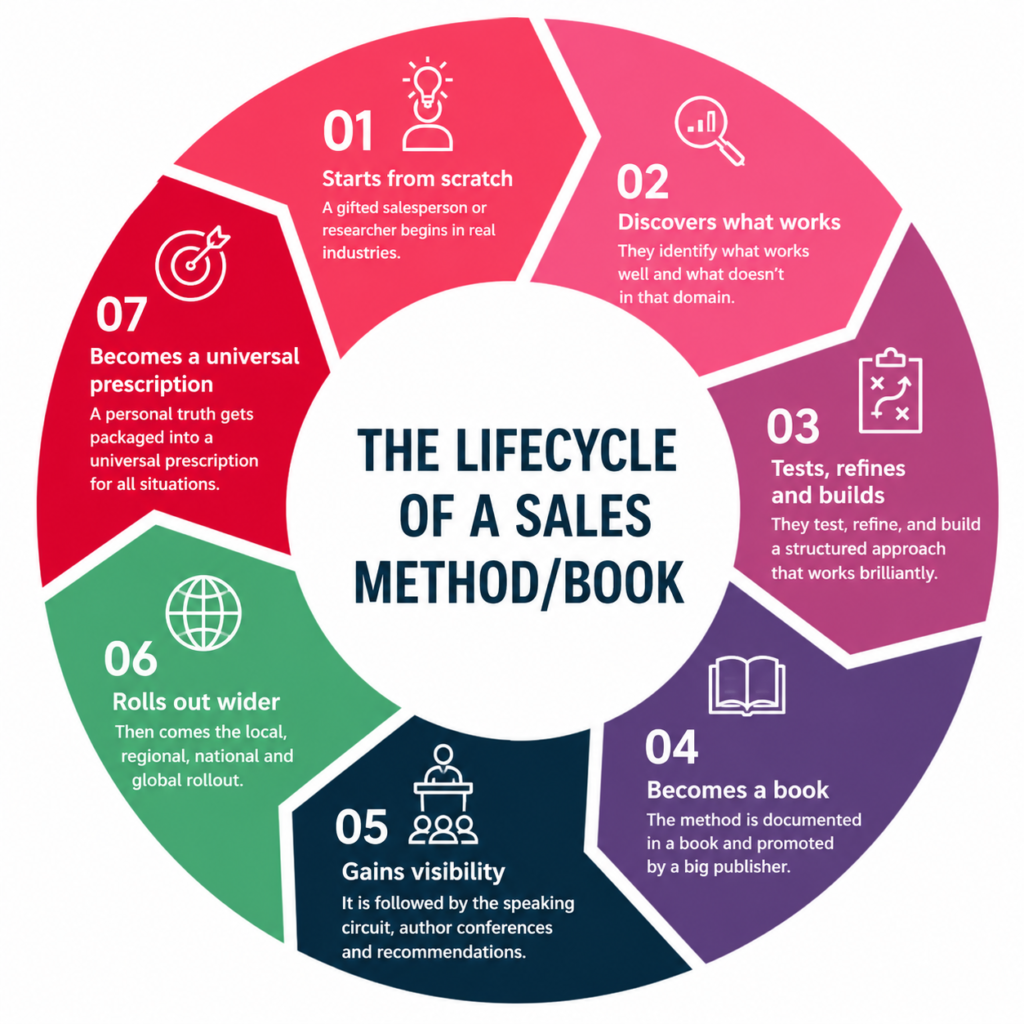
Most well-known sales frameworks follow the same arc.
And that is where the problem starts.
What began as one person’s hard-won insight becomes a checklist that thousands of sales professionals in dozens of industries are expected to follow and start following regardless of context.
A B2B Capital Goods sales rep in Mumbai is handed the same framework as an FMCG field sales executive in New York. A seasoned relationship builder with twenty years of network equity is trained identically to a fresh out of the school young hunter who has never met a real gatekeeper before.
Every sales model is someone else’s answer to someone else’s situation. It can give you a great deal of knowledge and skills. It may replace the thinking and hard work you need to do for yourself.
The frameworks are not wrong. They are incomplete and not full proof. And applying them without tweaking and using ones judgment is where sales performance breaks down.
Are the existing frameworks entirely useless. The answer is a big NO. Each framework has something good in them.
For E.g.
1. SPIN Selling gets one thing right: most salespeople talk too much and ask too little, and when they do ask, their questions are too shallow to surface real business challenges.
2. The Challenger Sales identifies something very important — buyers increasingly value salespeople who teach them something they did not already know, rather than simply reflecting their stated needs back at them.
3. Consultative selling’s skills core discipline of diagnosing and consulting and not prescribing remains as relevant today as it was when it was first articulated.
4. Relationship selling understands that trust is not a soft skill — it is a commercial asset.
The problem is not inside each model. The problem is the assumption that one model contains all the insight a salesperson needs — and that following it systematically will produce results across all industries, all customer types, and all selling environments.
The reality is that no single framework accounts for the complexity of real selling scenario. Not one.
Let’s look at what consistent Sales performers do differently.
They spend enough time observing genuinely high-performing sales professionals — not just those who break all targets in a buoyant market, but professionals who deliver consistently across different conditions and different years — and a pattern emerges which they try to integrate in their strategy.
These professionals read the Sales Books; however, they do not worship them. They have built something more valuable. A personal approach that is grounded in deep self-awareness, informed by careful observation of what works with their specific customers, and flexible enough to adapt when the situation demands it.
They are not running through a methodology checklist during a client conversation. They are reading the room and responding to what is in front of them and adapting to what the situation demands.
More importantly, they learn continuously — from their wins, from their losses, from watching other great salespeople, and from staying close to how their market is shifting.
They treat their approach as something that evolves, not something that was handed to them fully formed in a workshop.
That is the actual competitive advantage. And it is available to every sales professional willing to do the work of building it.
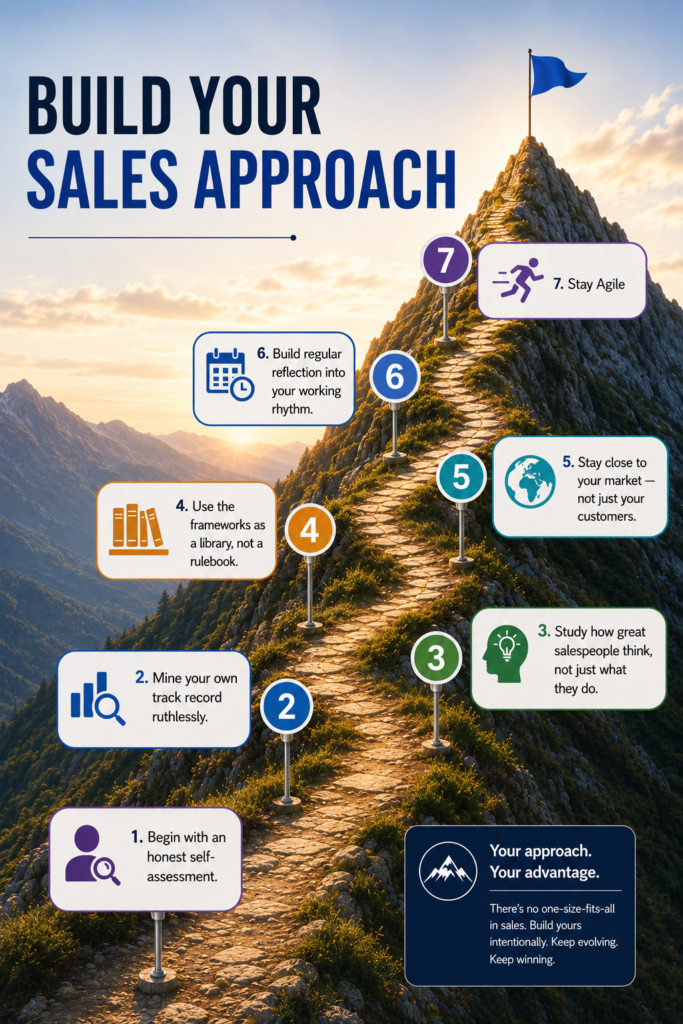
Building a personal sales approach is not a one-time exercise. It is an ongoing discipline. Here is how you can do so;-
Figure out what comes naturally to you. Is it building rapport, asking incisive questions, presenting ideas compellingly, holding firm under negotiation pressure?
Where do you consistently lose momentum?
Your approach must be built around your authentic strengths. Forcing yourself into a style that does not fit your personality creates friction that customers can sense immediately.
E.g. It like having a face like Virat Kohli and wanting to do a hairstyle like that of Sachin Tendulkar.
Look at your last twenty or thirty deals — wins, losses, and the ones that stalled and went nowhere.
What patterns emerge in your wins? Where in the process did your losses occur the most?
Most good salespeople do a quick debrief when they lose a deal and move on. Only the excellent ones spend equal time dissecting exactly what they did in their wins — the sequence, the language, the timing — so they can repeat it deliberately.
That is where your real successful model lives.
The actions of top performers are quite visible. The thinking behind those actions is where the real learning is. Sit with your best colleagues or mentors. Ask them how they read a customer who has withdrawn. How they decide whether to push or give space or to pull. How do they recover after a deal goes sideways. Understanding their decision-making process will teach you far more than watching their pitch.
Go back to every methodology you have been trained in. But ask a different question. Don’t ask “which one should I follow?” ask “what does each of these give me that is useful for my specific situation?” What tweaking is needed to the model that may work?
For E.g. Take the questioning discipline from SPIN. Take the insight-led opening from the Challenger. Take the long-term relationship investment from relationship selling. Curate deliberately. Leave the rest.
Buyer behaviors shift. Economic conditions change. Government policies change. New competitive dynamics emerge. New Products and services get introduced. What was a compelling value proposition twelve months ago may barely register today.
The salespeople who get caught off-guard by these shifts are the ones who only look inward at their own process. Make a habit of reading what your customers are reading.
Talking to them when you have nothing to sell and tracking how decisions are being made in your industry right now, not how they were made when you first learned to sell is important.
Monthly at a minimum, sit with your own performance and ask three questions:
This is not a performance review it is self-coaching. The salespeople who keep growing throughout long careers are the ones who never stop examining their approach.
There is a common fear among sales managers, they don’t encourage individual approaches and experimentation. This can produce chaos, inconsistency, and a team that cannot be coached. That fear is understandable. It is misplaced, however.
Agility in selling does not mean abandoning the structure.
It means having a strong personal foundation, a clear understanding of your strengths, a disciplined process, a deep knowledge of your customer and remaining genuinely open to adapting when the situation requires it.
The customer in front of you today is a unique person in a unique situation.
No methodology was designed for this variation. Your job is to bring everything you know and apply it with judgment, not to run a premade script.
The sales professionals who get this right have done the hard work of knowing their craft deeply enough and in a way that their adaptability looks effortless.
That depth comes from continuous learning, honest self-examination, and the willingness to keep refining an approach that is genuinely their own.
The frameworks will keep coming. Every few years a new book will arrive, a new acronym will circulate, and a new certification will promise to unlock sales success.
Read the books. Take what is useful. Respect the thinking that went into them.
But do not mistake that model for a strategy, for capability and for success.
And do not make the expensive mistake of assuming that if your team has been trained and certified on a methodology, they know how to sell.
Real sales capability the kind that holds up across market conditions, customer types, and competitive environments. It is built through deliberate observation, practice, honest self-evaluation, continuous learning, courage to experiment and the keep refining an approach that fits who you actually are.
There is no single formula for success in sales. That is not a limitation. It is the opportunity, because the most powerful thing in your selling career is something no competitor can replicate.
It is you.
Ready to Build a Sales Approach That Actually Fits?
Our sales training programmes don’t hand your team another framework to memorise. We work with your people to help them develop a selling approach grounded in their own strengths, your specific market, and the realities of today’s buyer — not yesterday’s textbook.
Explore Our Sales Training Programmes
The Yellow Spot | Corporate Training & Learning & Development
