

Close
Every quarter, in boardrooms across Mumbai, from BKC to Andheri and Lower Parel, a familiar scene plays out.
A high-performing employee gets promoted. There is applause, a new designation, perhaps a salary increase, and a team that the newly appointed manager is expected to lead. Everyone celebrates what appears to be a natural next step in the employee’s career.
Consider the story of Rohan, a fictional employee at a Mumbai-based financial services company. For six years, he has been one of the organisation’s most dependable performers. He delivers ahead of deadlines, handles demanding clients with confidence and is the person colleagues approach when a difficult problem needs solving.
When a managerial position opens up, Rohan is the obvious choice.
His promotion is announced at a team meeting. His manager congratulates him, senior leaders acknowledge his contribution, and HR updates his designation. Rohan is excited. He has worked hard for this opportunity, and he believes he knows exactly what it takes to succeed.
Six months later, however, the picture looks very different.
His team is missing deadlines. Two experienced employees have requested transfers. Meetings are becoming increasingly tense, and Rohan is spending long hours correcting work that he believes his team should have completed properly in the first place.
His manager is frustrated. HR is concerned about attrition. Rohan, meanwhile, cannot understand why a job he once imagined himself excelling at has become so difficult.
What went wrong?
The organisation promoted a capable individual but overlooked the transition from doing the work well to helping other people do it well. Rohan had been prepared for greater responsibility in terms of designation and expectations, but not necessarily in terms of capability.
This is precisely where first-time manager training in Mumbai becomes important. In a fast-paced business environment, organisations cannot assume that a promotion automatically equips someone to lead people.

Rohan’s story is not unusual. Across industries, organisations frequently promote employees because they have demonstrated excellence in their existing roles.
A successful salesperson becomes a sales manager. A technically brilliant engineer leads a project team. An outstanding analyst takes charge of a department.
The decision often makes sense. Organisations want experienced employees who understand the business, have earned credibility and can deliver results.
The problem begins when the new manager is expected to succeed using the same behaviours that made them successful as individual contributors.
As an individual contributor, Rohan was rewarded for solving problems quickly, handling complex work himself and ensuring that nothing slipped through the cracks. As a manager, those same habits can become obstacles.
When a team member makes a mistake, he steps in and fixes it. When a deadline approaches, he takes work away from others rather than coaching them through the challenge. When two colleagues disagree, he makes the decision himself without exploring the underlying issue.
Each action appears reasonable in isolation. Together, they create a team that increasingly depends on him.
The real transition is not simply from one designation to another. It is from personal execution to collective performance.
Research from Google’s Project Oxygen supports this distinction. Google’s work on manager effectiveness identified behaviours such as coaching, empowering employees, listening, supporting career development and making sound decisions among the characteristics of effective managers. Technical expertise alone was not the complete answer.
Rohan does not need to become less competent. He needs to use his competence differently.
For the first few months, Rohan’s manager assumes that he is adjusting to his new role. After all, every promotion comes with a learning curve.
But the consequences gradually spread beyond Rohan’s own performance.
Because Rohan is uncomfortable with mistakes, he reviews almost everything his team produces. His calendar fills with approvals, corrections and follow-up meetings.
His employees stop taking ownership because they know he will eventually intervene. Meanwhile, Rohan has little time for planning, developing his team or addressing larger business priorities.
The organisation has effectively promoted one of its best performers and reduced the time he can spend doing the work he was hired to do, without fully building his ability to lead others.
Rohan notices that one employee repeatedly submits incomplete reports. Instead of addressing the issue early, he becomes increasingly irritated and eventually criticises the employee during a team meeting.
The employee feels embarrassed. Rohan believes he has made his expectations clear. Neither walks away with a constructive plan to improve performance.
This is what happens when managers are expected to give feedback without being taught how to do it. They may understand that feedback is necessary but struggle to deliver it in a way that is specific, fair and useful.
Two members of Rohan’s team disagree about who is responsible for a delayed client deliverable. Rather than facilitating a discussion, he takes sides based on whose work he trusts more.
The immediate disagreement may end, but resentment remains. Other team members begin avoiding difficult conversations, and collaboration suffers.
Eventually, one of Rohan’s most capable employees resigns. The exit interview mentions limited growth opportunities and an unsupportive manager.
Leadership is surprised. The organisation had invested in hiring good people and offered competitive compensation. Yet it had paid insufficient attention to the person shaping those employees’ everyday experience at work.
Gallup’s State of the Global Workplace 2025 report found that only 44% of managers globally said they had received management training. Gallup also reported that managers who received training were less likely to be actively disengaged than those who had not. These findings underline why manager development deserves attention as an organisational priority, not merely an optional HR initiative.
In a competitive market such as Mumbai, the consequences of ineffective management can be especially costly when experienced employees have attractive alternatives.

If the consequences are so visible, why do organisations continue to leave newly promoted managers to learn through trial and error?
Rohan’s company illustrates three common reasons.
Sales training has a direct connection to sales targets. Technical training addresses a specific capability gap. Compliance training is tied to defined requirements.
Manager development can seem less immediate because its impact is distributed across delegation, feedback, engagement, conflict resolution and team performance.
As a result, it is often postponed until a problem becomes serious enough to demand attention.
Some employees do have natural strengths that help them lead. They may listen well, build relationships easily or remain composed under pressure.
But these strengths do not automatically prepare someone to handle every managerial responsibility. Even confident communicators need to learn how to address poor performance, delegate effectively, manage competing priorities and make difficult decisions.
Treating leadership as an innate quality leaves organisations relying on chance rather than systematically developing capability.
Rohan’s own manager was promoted without formal leadership training. He learned by observing others, making mistakes and gradually developing his approach.
Because he eventually succeeded, he assumes Rohan will do the same.
This is a form of survivorship bias. The organisation remembers the people who figured it out, while overlooking those who struggled, left or damaged team performance along the way.
A better question is not whether some managers can learn independently. It is whether the organisation should make that the default expectation.
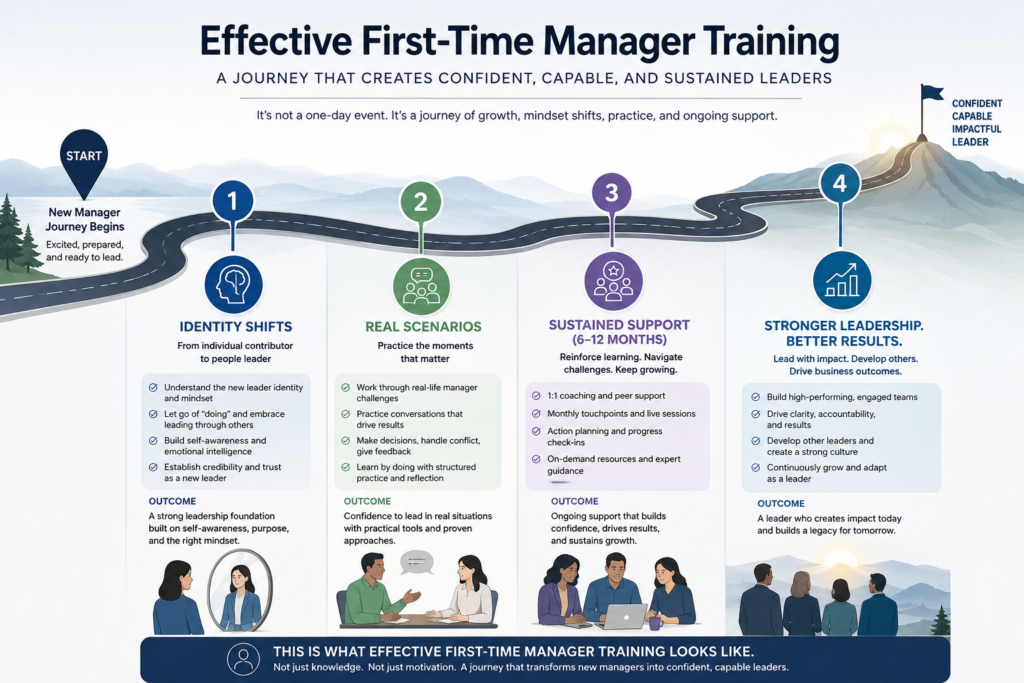
By the time HR steps in, Rohan’s organisation realises that sending him to a generic workshop on leadership will not be enough. He needs support with the situations he encounters every day.
Effective first-time manager training should address the behavioural transition into management, not simply introduce a collection of leadership theories.
Rohan must recognise that his job is no longer to be the person who can solve every problem fastest. His responsibility is to build a team capable of delivering results consistently.
This requires learning how to delegate outcomes, clarify expectations, establish checkpoints and allow employees room to make decisions.
A useful programme would let Rohan practise delegation through realistic scenarios. He would explore what to delegate, how much guidance to provide and when intervention is genuinely necessary.
The objective is not to remove accountability. It is to build capability without creating dependency.
Managers need to address missed deadlines, inconsistent performance, interpersonal tensions and unmet expectations.
Rohan could practise giving constructive feedback to an employee who has repeatedly missed deadlines, or having a career conversation with someone who feels overlooked for promotion.
These conversations should be practised, not merely discussed. Role-plays, simulations and facilitated feedback help managers explore their language, assumptions and reactions before they face similar situations at work.
New managers often face situations where there is no perfect answer. They must weigh business priorities, employee needs, available information and potential risks.
Rohan needs to learn when to decide independently, when to consult his team and when an issue must be escalated. He also needs to explain decisions clearly, especially when people disagree with the outcome.
Training should help him work through realistic dilemmas rather than simply memorise decision-making frameworks.
Rohan’s team members do not need him to provide every answer. They need him to help them think through problems, recognise their strengths and improve their performance.
Google’s new manager training materials include coaching, emotional intelligence, feedback and decision-making, reinforcing the value of developing these capabilities as part of the transition into management.
For Rohan, coaching might begin with a simple change. Instead of immediately solving an employee’s problem, he asks what the employee has considered, what options are available and what support is needed.
Over time, this can encourage greater ownership and independent problem-solving.
Google offers a useful example of how organisations can take manager effectiveness seriously.
Through Project Oxygen, Google examined the behaviours associated with effective managers. Its findings highlighted coaching, empowering teams, listening, supporting career development and making decisions, among other capabilities. Google subsequently incorporated these insights into manager development resources and training.
The important lesson for Rohan’s organisation is not to copy Google’s programme wholesale. It is to question an assumption that many companies continue to make: that employees will automatically know how to manage simply because they have performed well.
Google’s approach demonstrates the value of identifying specific managerial behaviours and translating them into development priorities.
For a Mumbai-based financial services company, those priorities might include delegation, stakeholder management, feedback and decision-making under pressure. For a manufacturing organisation, they might include team coordination, conflict resolution, safety conversations and performance management.
The content will vary, but the underlying principle remains the same. Define what effective management looks like in your context, then help people practise those behaviours.
Rohan attends a two-day managerial skills programme. He returns energised, with new tools for delegation, feedback and coaching.
For the next week, he makes a conscious effort to apply them. Then a major client escalation arrives. Deadlines tighten, his team makes mistakes, and he slips back into doing everything himself.
This is not necessarily a sign that the training failed. It is a reminder that awareness and lasting behavioural change are different things.
Organisations need to reinforce learning after the programme through practical assignments, manager check-ins, peer discussions and opportunities to reflect on real workplace situations.
For example, Rohan might set three development goals after training: delegate one important responsibility without taking it back, hold regular one-to-one conversations with each team member, and address performance concerns promptly rather than allowing frustration to build.
His own manager can review progress during monthly discussions. HR can gather feedback from participants and their teams, while the organisation tracks relevant indicators such as employee engagement, retention, performance and delegation effectiveness.
The objective is not to promise that every metric will improve immediately. It is to create a structured way to evaluate whether managers are applying their learning and where further support is needed.
Return to Rohan’s first day as a manager. The organisation celebrated his promotion, but it did not adequately prepare him for the responsibilities that came with it.
That gap is where many organisations lose the value of their own talent.
The answer is not to stop promoting high performers. It is to recognise that promotion creates a new development need. Employees who move into management require support to build the skills, judgement and behaviours their new role demands.
For organisations considering first-time manager training in Mumbai, the real question is not whether leadership development is a worthwhile investment. It is whether they can afford to leave such a critical transition to chance.
Every promotion is an opportunity to build leadership capability. With the right development, new managers can move beyond individual achievement and create the conditions for their teams to succeed.
At The Yellow Spot, we help organisations develop managers and leaders through practical, experiential and application-led programmes. Our approach focuses on the real challenges people face at work, from delegation and feedback to team leadership, conflict management and decision-making.
Because the best way to recognise a high performer is not simply to give them a team. It is to help them become the manager that team needs.