
Small Ways to Increase Organizational Effectiveness
Published: June 25, 2026
Last Updated: June 24, 2026
Every CEO and leader I have worked with has at some point said the same thing in different words, “we are doing everything right still why does it still feel slow, stuck or scattered?”

Strategy, vision, people, systems and processes are not usually the problem. The answer lies in its effectiveness. In the small, unglamorous systems that decide whether good intentions actually translate into outcomes.
It is also in how leaders make the decisions, how information travels, how people are held accountable and how the people in the organization behave when no one is watching.
Interestingly the organizations that have figured this out the best are not always the flashiest ones.
The roman catholic church has run on the same operating principles for close to 2000 years and it’s been super successful.
The Indian army runs units of thousands with almost no ambiguity about who decides what.
Companies like Toyota, Johnson & Johnson and Procter & Gamble have stayed relevant for over a century because they built systems that outlast individuals.
What is interesting is that the principles behind all of this are not complicated. They are small, repeatable and mostly about clarity.
This article looks at what those principles are, where they come from and how a leader can start applying them.
Strategy is about doing the right things, effectiveness is about whether those things actually get done, get done well and get done again and bring results without you personally pushing every time.
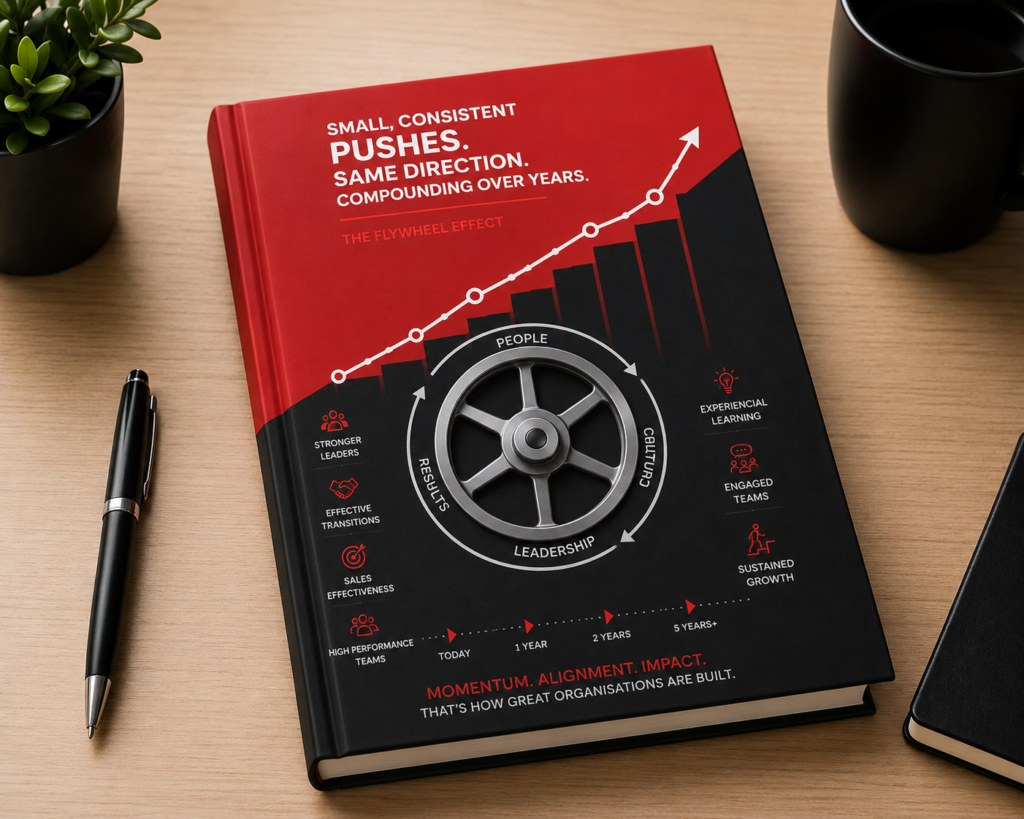
Jim Collins, in Good to Great, found through research spanning decades that companies which sustained greatness over long periods were not necessarily the ones with the most brilliant strategies. They were the ones with disciplined people, disciplined thought and disciplined action, operating consistently inside a simple framework. He called this the flywheel effect, small consistent pushes in the same direction, compounding over years. That is the core idea behind everything in this article. Organizational effectiveness is rarely about one big intervention. It is about small structural decisions that compound.
It sounds a bit technical but the idea is simple. Senior leadership defines the intent very clearly. What outcome they need and why it matters. They leave the ‘how’ to the people closest to the ground, because they have the most current information.
Most companies do the opposite. Leadership defines the how in painful detail and the why gets lost somewhere in a slide deck. The result is people executing tasks without understanding purpose and the moment something unexpected happens, everything stops because no one was trusted to think.
A second military concept worth borrowing is the after action review. Teams follow every significant activity, successful or not, with a short structured conversation. What was supposed to happen, what actually happened, why was there a difference and what do we do differently next time. No blame, just data. Very few companies do this consistently and it costs them enormously in repeated mistakes.
Companies that have lasted a century or more share a few traits that show up again and again in research. James Collins and Jerry Porras in ‘Built to Last’ studied companies like 3M, Johnson & Johnson, and Procter & Gamble. They found that the longest surviving organizations protected a core ideology, a set of values and purpose that did not change, while being extremely willing to change everything else, products, processes, structures, even leadership.
The lesson here is that effectiveness is not about rigidity. It is about being very clear on what should never change, so that everything else can change quickly without causing chaos. A second pattern from these companies is what Andy Grove, former Intel ceo, institutionalised through OKRs, objectives and key results.
A small number of clear priorities, cascaded down with measurable outcomes, reviewed frequently. Not a 40 page strategy document. Three to five things that matter, visible to everyone and revisited often.
A quick assessment for top leaders before the tools, it helps to know where your organization actually stands. This assessment covers five areas that consistently separate organizations that execute well from those that don’t.
1. Clarity of intent that people two levels below me can explain
2. Our top three priorities for this quarter without checking a document.
3. When priorities change, the reason for the change is communicated, not just the new instruction.
4. Decision right decisions get made at the level closest to the information, not escalated by default to the top.
5. There is a clear understanding across the organization of who decides what, without needing to ask.
6. Learning loops after a major project, win or lose, we have a structured conversation about what worked and what didnt.
7. Mistakes are treated as data rather than as something to hide.
8. People know exactly what they are accountable for and so does everyone around them.
9. When something falls through the cracks, we can usually trace why, without it becoming personal.
10. Culture and continuity our core values would still hold even if our entire leadership team changed tomorrow.
11. New joiners absorb how we operate within their first few months, without needing to be told repeatedly.
The ideas ahead will help you protect and refine what is already working.
One or two of these five areas is likely creating most of your friction.
The good news is that these are systems problems, not people problems, and systems can be redesigned and changed.
Not because anything is broken beyond repair, but because the cost of operating this way compounds quietly over years.
If you want a more detailed diagnostic, the organizational health index by Mckinsey and the Denison Organizational Culture survey are both well regarded paid assessments that go deeper into these areas with benchmarking against other companies.
Literally most organizational friction comes from ambiguity about who decides what. A simple exercise, list the ten most common decisions that get escalated unnecessarily, and assign clear ownership to the lowest level capable of making that call. This single exercise alone removes an enormous amount of bottlenecking.
Not a status meeting, a 15 minute conversation, once a week, where the only question is “are our top three priorities still the right three, and is anything blocking them”. Not a status update. A priorities check. This is the OKR cadence in its simplest form.
Get the team together for 30 minutes. What did we expect, what actually happened, why the gap, what do we carry forward. Do this even after successes, especially after successes, because success often hides the lucky breaks that won’t repeat.
Write down the three to five things about how your organization operates that should never change regardless of growth, market shifts or new leadership. Then explicitly give permission for everything else, processes, tools, structures, to be questioned and changed. This is the built to last principle in practice.
In high performing organizations, commitments are tracked not through memory but through visible systems and closing the loop is treated as seriously as making the commitment. A simple shared tracker with owners and dates does more for organizational discipline than most leadership offsites.

A manufacturing company we worked with had grown rapidly over eight years. Their revenue had tripled but the leadership team was exhausted. Every decision, even small ones, eventually landed on the founders desk. Meetings ran long because no one was sure who actually had the authority to close a discussion.
We started with one exercise. Mapping decision rights for the twenty most common recurring decisions. It took two sessions. by the end, fourteen of those twenty decisions moved down a level, with clear boundaries on what needed escalation and what didnt. Within two months, the founder reported spending visibly less time on operational firefighting, not because people suddenly became more capable. They had always been capable. Now they simply know it was their decision to make and they were trusted to make it
That is the essence of organizational effectiveness. It is rarely about adding more. It is about removing the ambiguity that quietly drains energy from everyone in the system.
Good to Great and Built to Last by Jim Collins remain the most rigorous studies on what separates organizations that sustain performance from those that don’t.
Measure what matters by John Doerr is the clearest practical guide to OKRs.
The Effective Executive by Peter Drucker, written decades ago, still holds up as one of the sharpest books on what leadership effectiveness actually looks like day to day.
Most of what is described here sounds simple, and it is, the difficulty is rarely understanding these ideas. It is finding the time and the outside perspective to actually implement them inside a busy organization.
At The Yellow Spot we work with leadership teams to diagnose where effectiveness is leaking and to build the small structural habits, decision rights, review cadences, priority systems, that compound over time. These are not large transformation programs. We design targeted interventions that fit into how your organization already runs.
If you are looking at strengthening organizational effectiveness in your leadership team, write to us or call us. We would be glad to design something that fits your context.
The Yellow Spot is a Mumbai based corporate training and L&D company with 16 years of experience in leadership, soft skills, sales effectiveness and people development. We work with organisations across India, the UAE, Mauritius and Malaysia.
