
Transactional Analysis Training: The Way Forward
Published: August 4, 2026
Last Updated: September 21, 2026

Somewhere between a difficult conversation with your teenager and a tense Monday morning stand-up, you’ve probably noticed the same pattern repeating itself with you. You say something reasonable and the other person reacts as if you’d scolded them. Or you ask a simple question to someone, and it comes back sounding like a complaint. If you’ve ever wondered why the same conversations keeps going sideways, Transactional Analysis can and has been answering that question for over past 76 years.
Transactional Analysis, or TA, was developed in the late 1950s by a Canadian-American psychiatrist Eric Berne. Trained in traditional psychoanalysis of Sigmund Freud, Berne grew restless with theories that took years to understand and explain and even longer to apply. He wanted something practical which a working adult could understand on a Tuesday and apply it by Friday.

By 1957, Berne had outlined the foundational pillars of TA, and in 1964 he published “Games People Play”, a book that turned a clinical psychology model into a cultural phenomenon that any layman could understand. It sold millions of copies and introduced everyday readers to the idea that our conversations follow our hidden patterns which we are not aware about. However by getting aware about our conversations we can get aware about our patterns and can change the ones that do not help us. Since then, TA has grown into a full therapeutic and organisational framework, used by counsellors, coaches, educators and corporate trainers across the world, with the International Transactional Analysis Association (ITAA) continuing to steward its research and practice today.
What makes TA endure is it’s clarity. Berne believed people are naturally OK, capable of thinking for themselves and able to change. That single idea “I’m OK, You’re OK” remains the emotional core of TA.
How Transactional Analysis Helps People in Family Life
Most family friction isn’t really about the dishwasher, the taste of food or who forgot to pay the rent. It’s about which “part” of us is doing the talking.
TA gives families a shared, judgment-free language for this. Instead of “you’re always so dramatic,” a parent might learn to notice about themselves, “I just spoke to my child from my Critical Parent and it triggered their Rebellious Child.”
That shift from blaming the other to the observation of the self and the other is where the real repair starts to begin.
Eric Berne proposed that we all operate from mainly three ego states: the Parent, Child and Adult.

None of the ego states is better than the others — the goal is knowing which one is driving the person at any given moment.
For example, a colleague messes up a report. From Parent: “You should have double-checked this before sending it.” From Child: “Ugh, why does this always happen to me?” From Adult: “Let’s see where the error is and fix it before the deadline.”
In TA every exchange between two people is called a transaction.
A complementary transaction is when the conversation starts from an adult state and the response is also from the adult state. This kind of transaction ensures a smooth flow of communication between two people.
A crossed transaction is, say, an Adult question met with a Critical Parent reply or a Free Child reply. This is where most conflict is born, as the response is from the opposite state. TA trains you to spot this crossing before it escalates into a conflict.
For example, boss (Adult): “Can you send me the sales figures?” Employee (Adult): “Sure, I’ll have them by 3 PM.” That’s complementary, smooth, no friction. But if the employee replies (Child): “Why is it always me who has to do this?” The transaction is crossed, and the conversation derails.
Berne called any unit of recognition by someone a compliment, a nod, even criticism as a “stroke.” People need strokes the way plants need sunlight, and much of our behaviour, good and bad, is designed to get them. Strokes are considered a basic survival need. A constant wrong one can destroy you, and the right one can lead to growth, while an excessive one can lead to a false sense of confidence.
For example, a manager saying “Great job closing that account” is a positive stroke. “You missed the deadline again” is a stroke, too negative, but still recognition. Silence, being ignored entirely, is the absence of a stroke and people often find that harder to bear than criticism.
These describe our default stance toward ourself and others. It’s about what mindset you operate from with regards to yourself and others.
I’m OK–You’re OK
I’m OK–You’re not OK
I’m not OK–You’re OK
I’m not OK–You’re not OK
Most personal growth work in TA involves moving steadily toward the first. These mindsets are a result of your persona, childhood, life experiences, and the people and environment around you.
For example, an employee whose idea gets rejected in a meeting might think: “Fair enough, let’s refine it together” (I’m OK-You’re OK), or “They just don’t get good ideas” (I’m OK-You’re not OK), or “I’m probably not cut out for this role” (I’m not OK-You’re OK), or “Nothing ever works here, why bother” (I’m not OK-You’re not OK).
A “game” in TA is a repeated, often unconscious pattern of transactions that ends in a familiar bad feeling — arguments that always end the same way, for instance.
A “script” is the larger life story we’ve been unconsciously following since childhood.
TA training helps people notice both, which is often the first step to changing them.
For example, a team member who always volunteers for extra work, then complains about being overloaded and unappreciated for every project, same pattern, same resentment is playing a game.
And someone who grew up hearing “money doesn’t grow on trees” and unconsciously plays it safe their whole career, avoiding risks even when opportunities are solid, is following a script written for them decades ago.
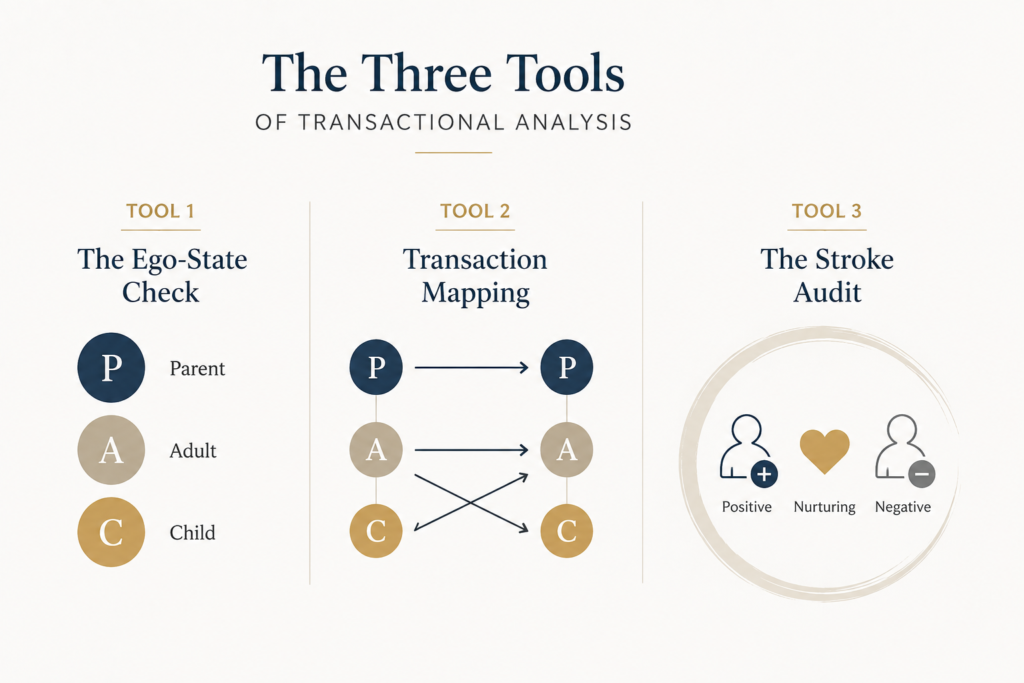
Before responding in a tense moment, pause and ask: Which state am I about to speak from?
Example: Your colleague misses a deadline.
Critical Parent: “This is exactly why I can’t rely on you.”
Adult: “The deadline slipped what got in the way, and how do we recover?” Same situation, entirely different outcome.
A more detailed walk-through: A key account manager promises a client a proposal by Friday but sends it Monday. Your first instinct (Critical Parent) is to say, “This is why I have to check on you constantly.” You pause, run the check, and notice this is Parent talking not Adult. You try again: “The proposal went out late, can you walk me through what happened.”
The colleague explains a vendor delay outside their control. Because you spoke from Adult, they respond from Adult too, and you end up problem-solving the vendor issue together instead of one person defending and the other attacking. The pause before speaking is the entire tool. It’s the gap where you catch yourself before the Parent voice takes over.
After a difficult conversation, write down what was actually said, and label each line as Parent, Adult, or Child. Patterns become obvious fast. Often you’ll find one crossed transaction is where the whole exchange derailed.
A more detailed walk-through: After a heated appraisal discussion, you write out the exchange line by line.
You (Adult): “Your numbers were below target this quarter, what is your read on it?”
Them (Adult): “Honestly, two of my key accounts delayed renewals, it’s not fully in my control.”
You (Critical Parent): “Everyone has that excuse however targets are targets.”
Them (Child): “Fine, whatever you say.”
Reading it back, the crossing is obvious in the line 3. The moment you shifted to Parent, they dropped into Child and shut down. If you rewrite line 3 as Adult it can be “Okay, let’s separate what’s controllable from what isn’t” and the whole conversation likely stays productive. The exercise isn’t about blame; it’s about spotting the exact line where the tone flipped, so you can catch it live next time.
For one day, notice how many positive strokes you give versus how many corrections. Many families and teams are stroke-starved without realising it; a small conscious increase in genuine recognition changes the emotional climate quickly.
A more detailed walk-through: A team lead decides to track this for one workday. By evening, the tally is 1 positive stroke (“nice catch on that error”) versus 11 corrections and reminders. No wonder the team seems flat and unresponsive lately as they’re running on almost no recognition. The next day, the lead makes a deliberate effort: acknowledging a well-handled client call, thanking someone for staying late, noting a clean report. By the end of that second day, two team members seem visibly more engaged in the group chat. Nothing else changed, the same workload, the same deadlines, just the ratio of recognition to correction. That’s the audit doing its job: it makes an invisible pattern visible enough to correct.
If you’d like to see your own ego-state pattern before diving into formal training, these are worth exploring:
IDRlabs Ego State Profile Test — a free, theory-grounded questionnaire based on the Ego State Questionnaire-Revised (ESQ-R)
Management’s Free TA Test — a 61-question self-assessment giving a percentage breakdown across Parent, Adult, and Child states
Emocare’s Ego State Online Test — a shorter, India-based version designed for general self-learning
None of these replace professional certification, but they’re a genuinely useful first mirror.
Lumturo Ego States Egogram — a digital tool for mapping your own egogram across ego states
Wisc-Online TA Self-Test — an interactive learning activity for identifying TA concepts in real scenarios
Games People Play – Eric Berne (the original, still the most readable entry point)
I’m OK, You’re OK – Thomas A. Harris (the popular classic that made life positions mainstream)
TA Today: A New Introduction to Transactional Analysis – Ian Stewart & Vann Joines (the modern, most-used training text)
ITAA (International Transactional Analysis Association) – the official body founded by Eric Berne; publishes “The Script,” a free monthly newsletter with TA articles and news
TA Podcast Resources page – curated TA book lists and further reading for newcomers
TA isn’t about diagnosing people, it’s about giving them back a sense of choice. Once you can see which “state” is speaking, you’re no longer stuck reacting on autopilot; you can choose the Adult response, the kinder stroke, the conversation that doesn’t repeat last week’s argument.
Ans. No. While it originated in psychotherapy, TA is widely used today in leadership training, parenting, education, and conflict resolution.
Yes, that was Berne’s entire intent. TA was designed to be understood in plain language by anyone.
Many people notice a shift in awareness within days of learning the ego-state model, though building new habitual responses typically takes a few weeks of conscious practice.
Very much so, TA is one of the most practical frameworks for improving manager-employee communication, feedback conversations, and team conflict.
Curious how a TA-based workshop could work for your team or organisation? The Yellow Spot designs facilitation sessions built around exactly these frameworks.
