Leader vs Boss: Key Differences That Define Great Leadership
Published: June 11, 2026

Think about the best manager you have ever worked with.
Now think about the worst.
Chances are, the difference wasn’t intelligence, experience, or technical expertise. It was how they made people feel.
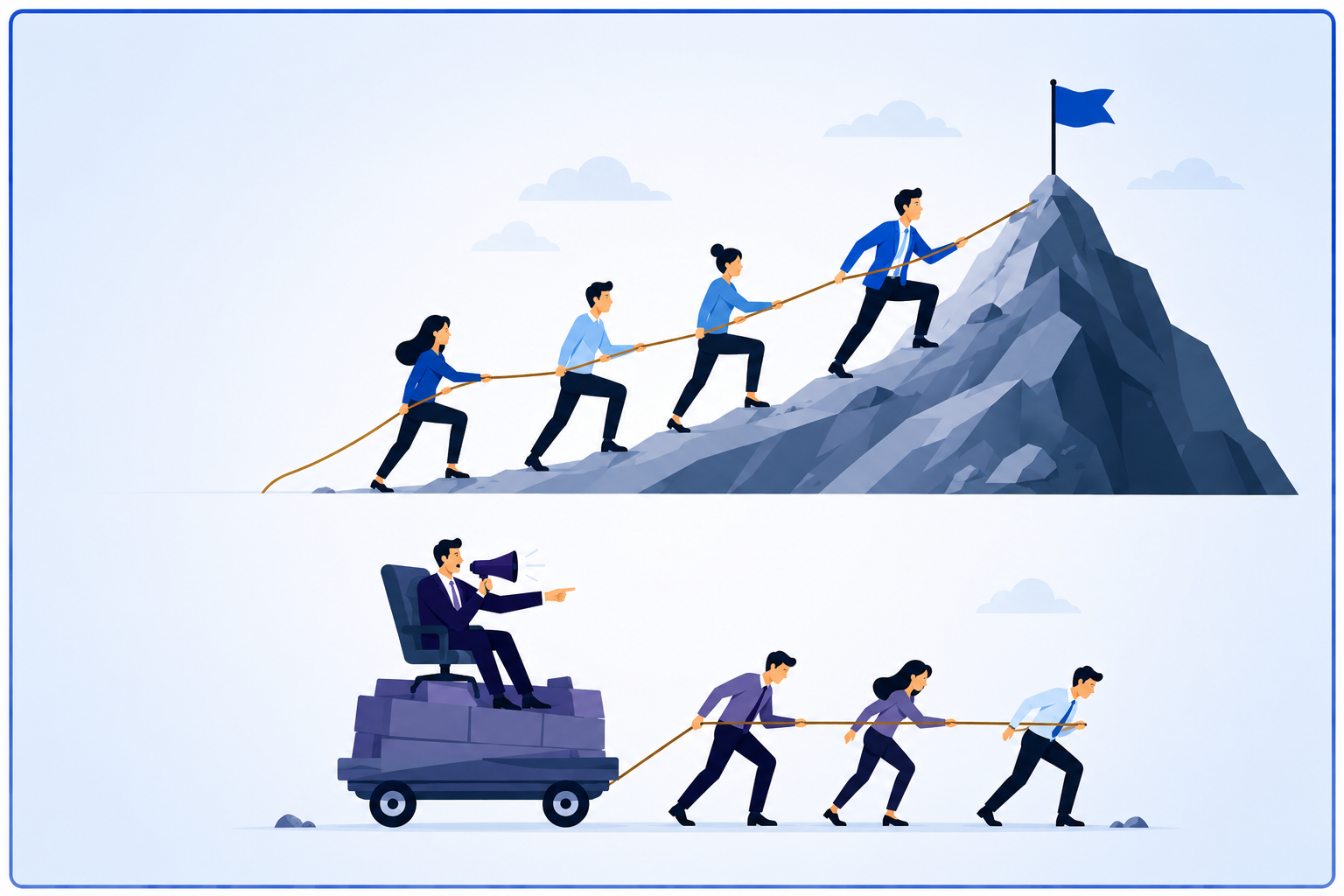
One person may have pushed work through authority, while the other inspired people to willingly give their best. One may have focused on control, while the other focused on growth. One acted like a boss. The other behaved like a leader.
The terms “leader” and “boss” are often used interchangeably, but they represent two very different approaches to managing people. Both may hold the same title, sit in the same office, and carry the same responsibilities. Yet the impact they create on their teams can be dramatically different.
In today’s workplace, where engagement, innovation, and collaboration matter more than ever, understanding the difference between a leader and a boss is critical. Organisations no longer need people who simply supervise work. They need individuals who can inspire ownership, build trust, and develop future leaders.
Let’s explore what separates a leader from a boss, why it matters, and how managers can make the transition from authority-driven management to influence-driven leadership.

A boss is someone who derives influence primarily from their position, title, or authority within an organisation.
Traditionally, bosses are responsible for assigning tasks, monitoring performance, enforcing policies, and ensuring targets are met. There is nothing inherently wrong with these responsibilities. In fact, every organisation requires structure, accountability, and oversight.
The challenge arises when authority becomes the primary tool for driving performance.
Bosses often focus heavily on control. They direct people on what needs to be done and expect compliance because of their role. Their communication tends to be top-down, with limited involvement from team members in decision-making.
Employees may follow a boss because they have to.
But compliance is not the same as commitment.
While this approach may produce short-term results, it often struggles to create long-term engagement, innovation, or loyalty.

A leader influences people through trust, credibility, and relationships rather than position alone.
Leaders understand that their primary responsibility is not simply to manage tasks but to enable people to perform at their best.
Instead of asking, “How do I get people to do this?” leaders ask, “How do I help people succeed?”
They communicate a vision, create clarity, build confidence, and remove obstacles. They focus on developing capability rather than creating dependence.
People follow leaders because they want to.
This distinction is important. Genuine leadership creates voluntary commitment. Employees become emotionally invested in goals because they understand the purpose behind them and feel valued as contributors.
Leadership is not about having followers. It is about creating an environment where people willingly contribute their best.
At its core, the difference between a leader and a boss comes down to influence.
A boss uses authority.
While a leader earns influence.
A boss says:
“Complete this task.”
And a leader says:
“Here’s why this matters.”
A boss focuses on controlling outcomes.
While a leader focuses on enabling outcomes.
The distinction may seem subtle, but its impact on culture, engagement, and performance is enormous.
Employees don’t experience leadership through organisational charts. They experience it through everyday interactions.
Imagine a project deadline is at risk.
A boss may react by demanding longer hours, increasing pressure, and questioning commitment.
A leader may start by understanding the root causes, removing obstacles, and helping the team prioritise effectively.
Both want results.
But the experience for employees is entirely different.
One creates stress.
While the other creates support.
Over time, these repeated experiences shape how people feel about their work, their manager, and the organisation itself.
Bosses often rely on their title to influence behaviour. Instructions are expected to be followed because of hierarchy rather than shared understanding.
When things go well, some bosses are quick to highlight their contribution while overlooking the efforts of the team.
The primary concern is often whether instructions were followed rather than whether employees understand or agree with the reasoning behind them.
Information is viewed as power. Communication may be selective, limiting transparency across the team.
Employees frequently rely on the boss for decisions because empowerment is limited.
Leaders understand that trust is earned through consistency, honesty, and reliability.
They actively invest in helping employees build new skills, confidence, and capability.
Success is celebrated collectively. Leaders recognise contributions publicly and generously.
Instead of solving every problem themselves, leaders encourage employees to think, decide, and act independently.
Perhaps the most important trait of a leader is the desire to develop others into leaders themselves.
One of the most widely cited examples of leadership comes from Satya Nadella.
When Nadella became CEO of Microsoft, the organisation was known for intense internal competition and siloed thinking.
Rather than relying on authority, he focused on transforming culture.
He encouraged curiosity over certainty.
Learning over knowing.
Collaboration over competition.
He introduced the concept of a “growth mindset” across the organisation and emphasised empathy as a leadership capability.
The result was not just a cultural shift but a business transformation. Microsoft regained momentum, innovation accelerated, and employee engagement improved significantly.
Nadella demonstrated that leadership is not about having all the answers. It is about creating conditions where others can succeed.
A common saying in the workplace is:
“People don’t leave companies. They leave managers.”
While not universally true, there is considerable truth behind it.
Employees often tolerate difficult work.
They tolerate pressure.
They even tolerate change.
What becomes difficult to tolerate is feeling unheard, undervalued, unsupported, or micromanaged.
Leaders create environments where people feel:
When these elements are present, engagement increases naturally.
But when they are absent, retention becomes difficult regardless of compensation or benefits.
Absolutely.
In fact, most leaders begin their journey as managers who initially focus heavily on tasks, deadlines, and authority.
The transition from boss to leader is less about changing roles and more about changing mindset.
It begins with recognising that leadership is not about having power over people.
It is about creating impact through people.
The most effective leaders continue asking themselves:
The answers reveal whether leadership is growing.
Many managers underestimate how powerful listening can be.
When employees feel heard, engagement rises immediately.
People commit more deeply when they understand the purpose behind decisions.
Rather than providing every answer, ask questions that help employees think through challenges independently.
Recognition costs nothing but creates significant motivational value.
Invest time in helping team members grow rather than simply evaluating their performance.
Ask yourself these questions:
The answers often reveal more about leadership than any formal assessment.
The workplace has changed dramatically.
Employees today seek more than a salary. They seek purpose, growth, flexibility, and meaningful relationships at work.
Command-and-control management styles are becoming increasingly ineffective in environments that require innovation, adaptability, and collaboration.
Modern organisations need leaders who can:
Technical expertise remains important. But leadership capability is what determines whether teams thrive.
A boss and a leader may occupy the same position, but they create very different experiences for the people around them.
Bosses focus on authority. Leaders focus on influence.
Bosses manage work. Leaders develop people.
Bosses seek compliance. Leaders inspire commitment.
The good news is that leadership is not reserved for a select few. It is a set of behaviours that can be learned, practised, and strengthened over time.
Every interaction presents a choice.
To command or to coach.
To control or to empower.
To supervise or to lead.
And those choices ultimately determine whether people merely work for us—or choose to follow us.
The Yellow Spot
At The Yellow Spot, we help managers make the transition from managing tasks to leading people. Through leadership development programs, coaching interventions, and experiential learning journeys, we enable organisations to build leaders who inspire ownership, strengthen team performance, and create lasting impact.
Because titles may make someone a manager.
But behaviour is what makes someone a leader.
